


African countries are expanding domestic solar production, but much of the higher-value technology, component manufacturing and upstream supply chain remains concentrated in China. The question is whether Africa’s energy transition can also become an industrial one.
Africa’s solar expansion is creating a second economic race alongside the race for electricity.
The first is about deployment: how quickly countries can install enough solar capacity to power homes, businesses and public infrastructure.
The second is about ownership: who manufactures the technology, controls the supply chain and captures the industrial value created by that demand.
Ethiopia, South Africa, Morocco and Nigeria are among the African economies working to expand domestic solar manufacturing.
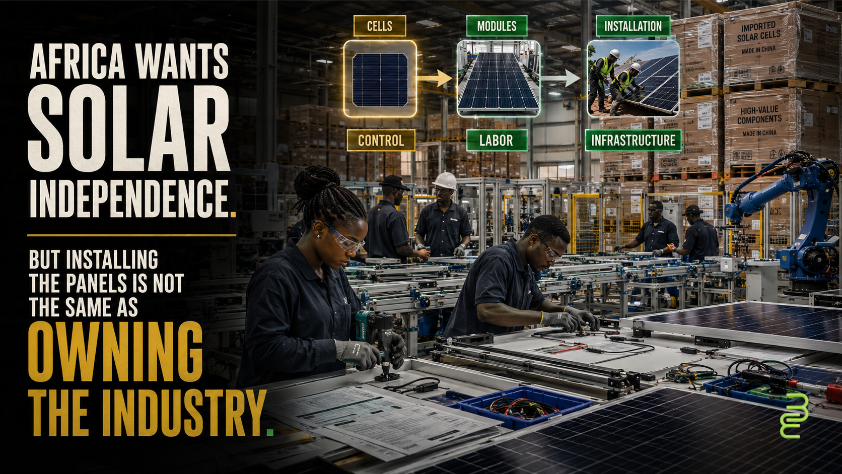
But much of that manufacturing remains concentrated in assembling finished modules from imported components.
The more technologically demanding parts of the solar supply chain — especially solar cells and other critical inputs — remain heavily dependent on China.
That distinction matters because Africa can become more energy independent without becoming more industrially independent.
Solar deployment solves one problem. Manufacturing solves another.
Installing solar panels can lower electricity costs, improve reliability and reduce dependence on fossil fuels.
But manufacturing the systems behind those installations creates something different.
It creates factories.
It creates engineering knowledge.
It creates supplier networks.
It creates intellectual property, skilled employment, export capacity and industrial expertise.
The solar economy includes far more than the finished panel mounted on a roof.
There are raw materials, wafers, solar cells, modules, inverters, battery storage systems, power electronics, software, engineering, installation, maintenance, financing and distribution.
Each part of that system captures a different share of economic value.
African businesses can create meaningful employment and revenue through module assembly and installation.
But the deeper economic question is whether African firms can move into the more sophisticated layers of the industry where technological capability and long-term industrial leverage are built.
China still controls much of the harder manufacturing
China enters Africa’s solar expansion from a position of enormous manufacturing scale.
African solar manufacturers continue to rely heavily on Chinese suppliers for important components, particularly solar cells and upstream inputs.
Chinese companies also play a major role in financing, supplying and constructing renewable-energy projects across the continent.
According to ODI Global data cited by the Associated Press, Chinese renewable-energy investment and related construction activity in Africa reached approximately $66 billion between 2010 and 2024.
That investment can help African countries expand electricity generation and build renewable-energy infrastructure faster.
But it can also reinforce an industrial imbalance if localization ends with assembly while technology, production equipment and higher-value manufacturing remain elsewhere.
Both things can be true at the same time.
Chinese investment can accelerate Africa’s energy transition while Chinese companies continue capturing a significant share of the manufacturing upside behind that transition.
South Africa is trying to move deeper into the value chain
South Africa offers one of the clearest examples of how governments are beginning to think beyond solar deployment.
Eskom, South Africa’s state-owned electricity utility, is also exploring whether the country could move deeper into solar manufacturing.
In 2026, the utility sought a feasibility study for a proposed “vertically integrated solar photovoltaic manufacturing facility.” It’s a potential operation that could bring multiple stages of solar production under one industrial system.
A country that only assembles imported components participates in the industry, while a country that manufactures more of the cells, components and equipment behind those products captures more of the productive system.
That word — integrated — matters.
A country that only assembles imported components participates in the industry.
A country that produces more of the cells, components, equipment and technology behind those products captures a larger portion of the productive system.
The more stages of production that occur domestically, the more opportunities there are for local suppliers, engineers, workers and investors to capture economic value.
Cheap imports create a difficult industrial tradeoff
China’s dominance is not simply a story about dependency.
Its manufacturing scale has also helped make solar equipment dramatically cheaper.
For African countries facing electricity shortages, high energy costs or unreliable grids, inexpensive solar technology is valuable.
Lower equipment costs can accelerate adoption.
That creates a difficult policy problem.
The cheapest imported solar equipment today may compete directly with the domestic factory a government hopes to build tomorrow.
African manufacturers must develop production capacity, supplier networks and technical expertise while competing against firms operating at massive global scale.
Governments therefore face a balancing act.
Protect domestic manufacturers too aggressively and solar deployment could become more expensive.
Rely indefinitely on low-cost imports and African economies may surrender much of the industrial upside associated with one of the largest infrastructure transitions of this century.
The issue is not whether imports are inherently good or bad.
The issue is whether African industrial policy is creating a realistic path for local companies to move into increasingly valuable parts of the supply chain.
Follow the money through the solar stack
Consider what happens when an African household, business or government purchases a solar system.
Some of that spending can remain within the local economy.
- Installers get paid.
- Electricians get paid.
- Retailers, distributors and maintenance companies generate revenue.
- Local financing firms may participate.
But another portion of that money flows outward through imported panels, solar cells, inverters, batteries, manufacturing equipment and proprietary technology.
That is why the location of production matters.
The economic-development opportunity is not simply to sell more panels.
It is to increase the number of layers where African firms own productive assets and retain revenue.
Modules create manufacturing activity.
Solar cells create deeper technological capability.
Inverters and batteries open additional industrial opportunities.
Engineering and software create knowledge assets.
Financing determines who earns from the capital required to deploy the infrastructure.
Distribution determines who owns the customer relationship.
The solar system is also an economic system.
And installed capacity alone does not reveal who owns it.
Africa’s growing market creates leverage
Africa’s demand for solar power is rising quickly.
That growth matters because a large market is not only a customer base.
It can also become industrial leverage.
Governments can use procurement to encourage domestic sourcing.
Development banks can finance manufacturing capacity alongside electricity projects.
Joint ventures can be evaluated according to whether they actually transfer technical knowledge and production capability.
Training programs can build the engineers and technicians required for more sophisticated manufacturing.
Regional trade can give African manufacturers access to markets larger than any one national economy.
And industrial incentives can help domestic companies move from assembly into components, systems and technology.
None of this means every solar component must eventually be produced inside Africa.
Modern manufacturing supply chains are global.
Industrial independence does not require complete self-sufficiency.
It requires enough domestic capability to create bargaining power, resilient businesses, technical knowledge and meaningful participation in the higher-value parts of the industry.
The biggest risk is replacing one dependency with another
Africa urgently needs more reliable and affordable electricity.
Solar can help provide it.
But the energy transition could produce two very different economic outcomes.
In the first, Africa becomes one of the world’s fastest-growing markets for renewable technology while continuing to import much of the productive capacity behind it.
Consumers, businesses and governments finance adoption.
Foreign manufacturers capture much of the industrial value.
African firms remain concentrated in distribution, installation and lower-value assembly.
In the second outcome, rising demand becomes the foundation for a deeper industrial base.
African companies manufacture more cells, batteries, inverters and components.
Engineers develop technical expertise.
Local suppliers emerge.
Factories scale.
Financing institutions gain experience supporting clean-energy manufacturing.
Regional export markets grow.
The difference between those two outcomes is ownership.
The ownership question
Africa’s solar boom presents the continent with two separate opportunities.
The first is an energy opportunity.
More households, businesses and institutions gain access to reliable electricity.
The second is an industrial opportunity.
African firms gain factories, technology, supplier relationships, skilled labor, financing capability and export markets from producing the systems behind that electricity.
The first matters urgently.
The second determines how much long-term wealth stays on the continent.
Africa does not have to manufacture every component in order to benefit from the solar transition.
But if the continent remains primarily a buyer, assembler and installer while the most valuable technologies and productive assets remain controlled elsewhere, the energy transition could reduce one form of dependence while reinforcing another.
Africa is installing more of the future. The economic question is how much of that future it will own.
The Economics Behind It
The strategic asset is not simply the solar panel.
It is the productive system surrounding it: factories, technology, component manufacturing, engineering knowledge, capital, suppliers, financing and distribution.
Africa captures substantially more economic value when rising solar demand produces domestic industrial capacity instead of primarily generating additional imports.
Why It Matters
The renewable-energy transition may become one of Africa’s largest industrial investment cycles.
If African economies remain primarily consumers and installers, much of the resulting wealth can accrue outside the continent.
If local firms move deeper into manufacturing, technology, financing and supply-chain ownership, the same energy transition could help build industrial capability and long-term economic power.
Ownership Question
Africa needs affordable solar power now, but it also needs productive capacity for the future.
Which should governments prioritize most: the lowest-cost equipment today, or policies that help build domestic manufacturing tomorrow?

Latest posts by normbond (see all)
- HUD Is Investigating Wells Fargo’s Black Homeownership Programs. The Stakes Go Beyond One Bank. - October 8, 2026
- How Warren Thompson Turned Corporate Contracts Into a Black-Owned Hospitality Empire - October 7, 2026
- Beyoncé Funded Cécred Herself. Now the Real Test Is Global Distribution. - October 2, 2026