


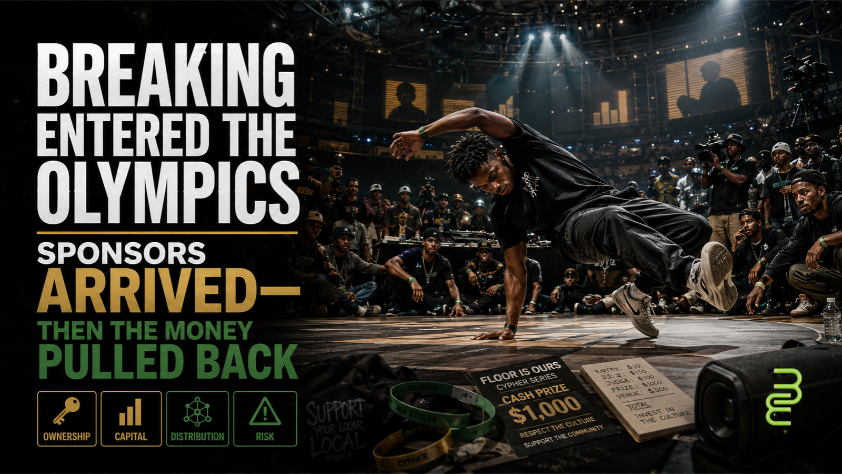
Breaking made it to the Olympics.
For a culture born decades earlier in hip-hop communities in the United States, Paris 2024 represented a level of institutional recognition that once would have been difficult to imagine.
The money followed.
Veteran breaker Omar Delgado, better known as Roxrite, told Reuters that Olympic inclusion helped generate stronger brand support and larger prize pools.
Then the commercial momentum weakened.
According to Roxrite, brands began pulling back after Paris and prize money contracted. Meanwhile, one of the Games’ most mocked performances became one of the most recognizable images associated with breaking around the world.
That sequence reveals something larger than a sports story.
It shows the economic difference between being visible inside someone else’s system and controlling the system that turns visibility into durable value.
The Olympics expanded breaking’s market
Breaking was added to the Paris program as Olympic organizers sought to connect with younger audiences.
That decision did more than put dancers on a global stage.
It changed the commercial environment around the culture.
Roxrite told Reuters that sponsors increased their involvement and larger prize pools began to emerge as the Olympics approached.
For elite breakers, that created the possibility of more competition income, sponsorship dollars and mainstream recognition.
For brands, breaking offered something else: access to a global youth culture with decades of credibility behind it.
The Olympics effectively created a new institutional wrapper around an existing cultural asset.
But the underlying culture had existed long before that wrapper appeared.
That distinction matters.
Visibility did not mean control
The breaking community could perform on the Olympic stage.
It did not control how that stage was presented, distributed or ultimately remembered.
Australian breaker Rachael Gunn, known as Raygun, became the center of widespread ridicule after losing all three of her round-robin battles without scoring a point. Her unconventional routine spread rapidly across social media and became a dominant reference point for breaking’s Olympic appearance.
David Shreibman, the breaker known as Kid David, told Reuters that for millions of people, breaking effectively became synonymous with Raygun.
That is a distribution problem as much as a cultural one.
- The breakers created the underlying art form.
- Olympic institutions controlled the global sporting platform.
- Broadcasters and social platforms controlled enormous portions of distribution.
- Brands controlled where sponsorship capital went.
And now Netflix is preparing Untold Raygun: Breaking Badly, giving another outside platform significant influence over how millions of viewers may encounter the Olympic breaking story.
None of that means those institutions are illegitimate participants.
It means their economic power is different from the power held by the people who built the culture.
When perception changed, capital could leave
The sharpest economic signal may be what happened after the Olympic attention faded.
Roxrite told Reuters that breaking lost significant brand support after Paris and saw prize money shrink.
The community, he said, has had to return to being grassroots and independent.
That exposes a recurring weakness in cultural markets.
- Outside capital can arrive quickly when attention is high.
- It can leave just as quickly when the attention cycle changes.
The people who sustain the culture do not have the same option.
They continue teaching.
They continue organizing events.
They continue training dancers.
They continue maintaining reputations, institutions and relationships that existed before sponsors arrived and remain after sponsors leave.
That means the culture can carry much of the long-term operating risk while outside institutions decide when the opportunity is commercially attractive.
Breaking already had an economy before the Olympics
The story is not that breaking disappeared when Olympic momentum slowed.
It did not.
Veteran breaker Ronnie Abaldonado told Reuters that the community already had its own ecosystem before Paris. He said he has seen more students coming to learn breaking in Las Vegas and described the Olympic experience as motivation to prove more about the culture.
Breaking also remains connected to the Olympic movement through the Summer Youth Olympics in Dakar.
And an important distinction should be made about Los Angeles 2028: breaking was left off that Olympic program before the Paris Games took place.
So the question is not whether one viral controversy single-handedly cost breaking its Olympic future.
The more useful economic question is what happened to the capital that temporarily accumulated around the culture when institutional attention was at its highest.
The Black economic question underneath the story
Breaking emerged from the Black and Latino cultural infrastructure of early hip-hop.
That makes its Olympic experience part of a much longer economic pattern worth examining.
Black-originated culture can become extremely valuable to broadcasters, advertisers, entertainment companies, platforms and major institutions.
But cultural creation and economic control are not the same thing.
The people who build a cultural form may hold enormous creative legitimacy while having far less control over sponsorship markets, global distribution, media framing and institutional access.
Breaking’s Olympic moment made that imbalance unusually visible.
- The culture produced something institutions wanted.
- The institutions expanded its audience.
- Sponsors expanded the money surrounding it.
But when the commercial environment shifted, the grassroots culture was left to absorb much of the downside and rebuild momentum through the infrastructure it already possessed.
What would durable economic power look like?
The lesson is not that breaking should reject large institutions, sponsors or streaming platforms.
Those relationships can create real opportunity.
The issue is dependency.
A culture is economically stronger when outside attention becomes an additional source of capital rather than the foundation underneath the entire market.
That raises harder questions.
- Can major breaking competitions build stronger direct relationships with audiences?
- Can dancers and organizers own more of their event, media and intellectual-property economics?
- Can sponsorship revenue help finance institutions that remain after a brand campaign ends?
- Can the culture build distribution powerful enough that one viral mainstream narrative does not become the market’s primary definition of breaking?
Those are ownership questions.
And they extend well beyond breaking.
For Black cultural ecosystems in music, dance, fashion, sports and digital media, visibility can produce tremendous value.
But visibility controlled by somebody else can also disappear on somebody else’s timetable.
The more durable question is what the culture owns when the spotlight moves.
The Economics Behind It
Money: Olympic inclusion helped attract sponsorship and larger prize pools. Veteran breakers say some of that capital retreated after Paris.
Ownership: Breakers created and sustain the cultural practice, but they do not own many of the major institutions that determine global distribution, sponsorship or mass-media framing.
Control: Olympic organizers controlled the sporting platform. Sponsors controlled capital allocation. Broadcasters, social platforms and streaming companies influence which narratives reach mass audiences.
Access: Olympic inclusion opened new commercial and audience access, but that access was tied partly to institutions outside the breaking community.
Risk: Breakers carry reputational and financial consequences when mainstream perceptions deteriorate and sponsors withdraw.
Upside: Brands, platforms, promoters and elite competitors can all benefit during peak attention. The unresolved question is how much of that temporary attention becomes durable community-owned economic infrastructure.
Why It Matters
The story is bigger than whether breaking returns to the Olympics.
It is about what happens when a Black- and Latino-originated cultural asset enters a powerful institutional marketplace without controlling much of the infrastructure around capital, presentation and distribution.
Exposure can create opportunity.
Ownership determines whether that opportunity lasts.
The unlock question: What economic infrastructure does a culture need so sponsorship and narrative power do not disappear when outside institutions move on?
Subscribe to The Economics Behind It for reporting on who owns, controls and captures the value created by Black culture.
Latest posts by normbond (see all)
- Burkina Faso Rejected a U.S. Deportation Deal. Then the Fight Moved to Visa Access. - October 19, 2026
- NC A&T Students Marched 45 Minutes to Vote. The Bigger Story Is Who Controls Access. - October 17, 2026
- Black Family Wealth Fell 25%. The Ownership Gap Is the Bigger Story. - October 16, 2026