


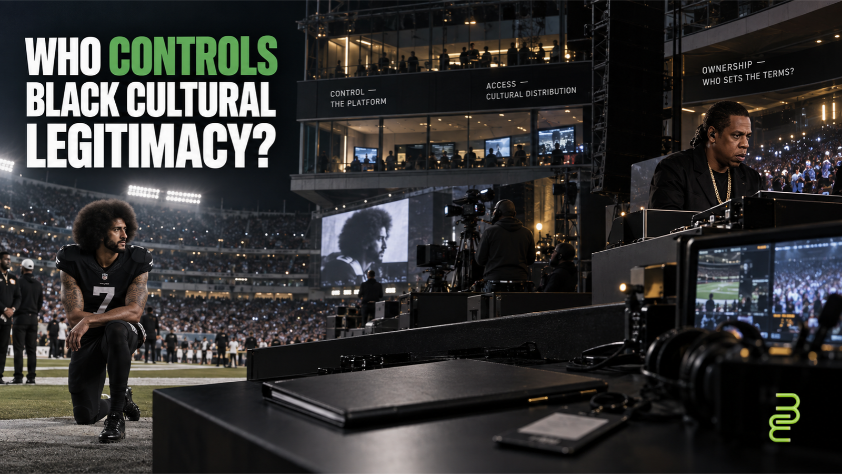
Colin Kaepernick has reopened the debate over Jay-Z’s relationship with the NFL.
But the most important question may not be whether the two men agree about protest.
It is what happens economically when a powerful institution needs access to cultural credibility that it does not own.
In a new MeidasTouch interview, Kaepernick argues that NFL owners were searching for a prominent Black figure who could help move the league beyond the player protests that began after he took a knee against police brutality and racial injustice.
Kaepernick says the NFL first tried to work through the Players Coalition.
He also says the league approached him with a major offer to lead its social-justice initiatives, which he rejected.
He then connects that history to the NFL’s 2019 partnership with Jay-Z’s Roc Nation, arguing that Jay-Z ultimately occupied the institutional role owners had been looking to fill.
That last connection is Kaepernick’s interpretation, not an established finding about why the NFL partnered with Roc Nation.
But the underlying history makes the economic question worth examining.
NFL owners were already discussing Black representation
The NFL’s struggle over player protests had become both a cultural and institutional problem by 2017.
Contemporary ESPN reporting from an owners-and-players meeting described Buffalo Bills owner Terry Pegula suggesting that former player Anquan Boldin could become a spokesman for the league’s work on social issues because that role could not be filled by a white owner and needed to be held by someone Black.
Eric Reid, one of the players who protested alongside Kaepernick, later recalled responding that if the movement needed a face, it should be Kaepernick.
Kaepernick now gives that history a sharper interpretation. He says owners were not simply looking for representation. He believes they were looking for a Black intermediary capable of moving the institution away from a protest it could not fully control.
That distinction matters.
Representation can provide visibility.
Intermediation can provide access, credibility and a new channel through which an institution manages its relationship with a community.
Those things have economic value.
Then came Roc Nation
In 2019, the NFL announced a multiyear partnership with Roc Nation, the entertainment company founded by Jay-Z.
The agreement made Roc Nation a strategic adviser on live music entertainment, including major NFL performances such as the Super Bowl, and connected the company to the league’s Inspire Change social-justice initiative. The two sides also planned to create and distribute music-related content.
Inspire Change itself predated the Roc Nation deal.
The NFL formally launched the platform earlier in 2019 around education and economic advancement, police-community relations and criminal-justice reform, working with players, teams and the Players Coalition.
Jay-Z defended the partnership at the time as an opportunity to use the NFL’s enormous platform to produce action. He argued that entertainment and social change did not have to be mutually exclusive.
Kaepernick sees the same agreement very differently.
That disagreement is where the economics become more interesting than the celebrity conflict.
Cultural legitimacy can function like an asset
The NFL owned the teams’ shared league infrastructure, its central commercial platform and access to football’s biggest stages.
What it did not automatically own was legitimacy with every segment of Black culture.
That distinction matters whenever an institution faces pressure from a community that helps create its cultural and commercial value.
A company does not necessarily need to purchase the culture itself.
It can form a relationship with an intermediary that already has cultural access, trust, audience relationships or creative influence.
Roc Nation brought something the NFL could not manufacture internally: deep relationships across music, entertainment and Black popular culture.
The NFL brought something Roc Nation could not reproduce independently: one of the largest sports-distribution systems in the United States and access to stages such as the Super Bowl.
The partnership therefore connected two different kinds of power.
One side controlled the institutional platform.
The other possessed cultural reach and influence.
That does not prove Kaepernick’s claim that the purpose of the partnership was to end or neutralize protest. The NFL publicly described the agreement in terms of entertainment and social-impact work.
But it does reveal why cultural legitimacy belongs in an economic conversation.
Access is not ownership
There is another distinction that can disappear when celebrity partnerships are described as simple wins for representation.
Access to an institution is not the same as ownership of it.
Roc Nation gained influence within the NFL ecosystem. It did not acquire control of the league.
The NFL gained access to Roc Nation’s entertainment expertise and cultural relationships. It did not acquire ownership of Roc Nation.
And the movement that created much of the original institutional pressure remained separate from both.
That produces three different forms of leverage: protest from outside the institution, partnership from inside it and ownership of the institution itself.
They should not be confused.
Outside pressure can force an institution to respond.
Inside access can influence what that response becomes.
Ownership determines who ultimately controls the platform, its rules and much of its underlying economic value.
The question is bigger than Jay-Z
Reducing this story to whether Jay-Z betrayed Kaepernick misses the structural lesson.
Corporate America regularly enters relationships with creators, athletes, executives, nonprofits and cultural figures who possess credibility that the institution itself lacks.
- Sometimes those partnerships create genuine resources and new access.
- Sometimes critics believe they convert outside pressure into institutionally manageable programs.
- Sometimes they do both.
The better economic question is not whether every partnership represents co-option.
It is what actually changes after the partnership is signed.
Who controls the decision-making?
Who receives the money?
Who gains access?
Who owns the resulting intellectual property, audience relationships and distribution?
Who can walk away?
And what measurable power reaches the people whose demands created the pressure in the first place?
Kaepernick’s new argument puts those questions back on the table.
The NFL-Roc Nation relationship may have started as a sports-and-entertainment partnership.
But viewed through the economics of cultural legitimacy, it also offers a case study in what can happen when an institution with enormous structural power meets cultural influence it cannot simply create for itself.
That is where the ownership question begins.
Black cultural legitimacy can create bargaining value even when the people generating that legitimacy do not own the institution seeking it.
The crucial question is whether a partnership converts cultural influence into durable ownership and decision-making power—or primarily into access within somebody else’s system.
This framework applies well beyond the NFL. Brands, platforms, universities, media companies and other institutions routinely seek relationships with Black cultural figures when they need reach, trust, creative relevance or community access.
The economic test is what those relationships transfer:
money, ownership, control, access—or merely visibility.
Latest posts by normbond (see all)
- MACRO Bought ALLBLK. The Bigger Prize Is the Direct Relationship With Black Viewers. - September 18, 2026
- Kaepernick Says Jay-Z Gave the NFL Something It Couldn’t Own: Black Cultural Legitimacy - September 18, 2026
- Nairobi Won the 2029 World Athletics Championships. Now Comes the Ownership Test. - September 15, 2026