


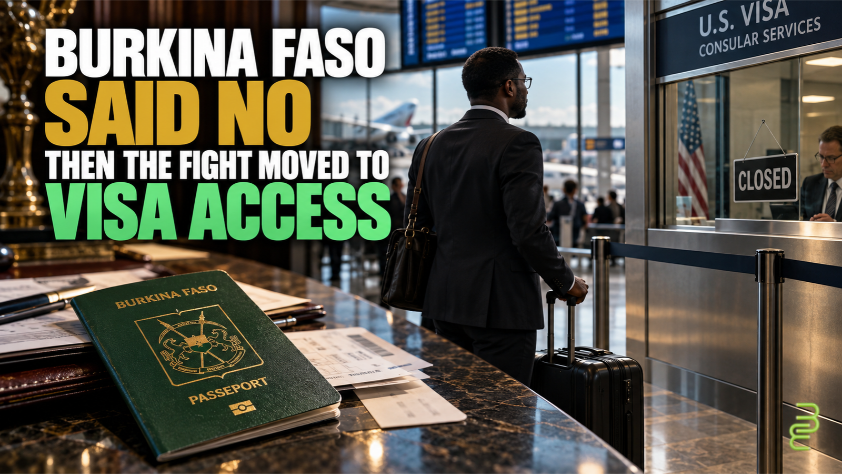
Burkina Faso said no.
In October 2025, the West African nation rejected a U.S. proposal to accept people deported from the United States who were not Burkinabè citizens.
Foreign Minister Karamoko Jean-Marie Traoré called the proposal “indecent” and argued that Burkina Faso would not become a destination for people another country no longer wanted.
That answer traveled quickly across social media.
For supporters of Burkina Faso’s military-led government, it looked like another example of an African country asserting its sovereignty against a global power.
But the bigger story did not end with the word “no.”
Within days, visa access was at the center of the dispute.
And once access enters the conversation, so do economics.
The visa door started closing
On October 8, 2025, the U.S. State Department announced that its embassy in Ouagadougou would pause all routine visa services beginning October 10.
That included immigrant visas along with most nonimmigrant visas for tourists, business travelers, students and exchange visitors. Diplomatic and certain official visas remained available.
Washington said it was reviewing its screening and vetting procedures in the interest of national security and public safety.
Burkina Faso saw the timing differently.
Traoré questioned whether the visa decision was being used as pressure after his government rejected the deportation proposal.
Burkina Faso called it pressure. Washington called it vetting.
But for Burkinabè citizens, the practical issue was bigger than the diplomatic argument.
The gate had become harder to get through.
A visa is not just a travel document
That matters because international mobility has economic value.
A visa can determine whether a student reaches a university.
It can determine whether an entrepreneur attends a meeting, whether a researcher joins an exchange program, whether a professional gets to a conference or whether a family can maintain connections across borders.
For businesses, workers and students, mobility can be part of the infrastructure required to reach opportunity.
So when governments restrict mobility, the costs can move far beyond foreign ministries.
They can land on people who never sat at the negotiating table.
That is what makes this more than an immigration story.
Access is an economic asset.
And governments control it.
By 2026, the restrictions went much further
The October pause was not the end of the story.
Effective January 1, 2026, the United States fully suspended visa issuance to nationals of Burkina Faso across immigrant and nonimmigrant categories, with limited exceptions.
Burkina Faso was among 19 countries covered by the full suspension.
Exceptions included certain diplomatic and official travelers, some Special Immigrant Visa applicants, dual nationals using passports from countries not subject to the restriction and participants in certain major sporting events.
The presidential proclamation behind the policy cited terrorist activity in Burkina Faso, visa-overstay rates and what it described as the country’s historical refusal to accept back removable nationals.
Now the economic stakes were larger.
What began as a dispute over whether Burkina Faso would accept third-country deportees was unfolding alongside a much broader restriction on Burkinabè access to the United States.
That matters because borders do not carry equal economic weight.
Sovereignty is real. So is unequal leverage.
Burkina Faso has the sovereign authority to decide who it allows into its territory.
The United States has the sovereign authority to set rules governing entry into its territory.
But those two powers do not produce equal economic consequences.
The United States sits at the center of enormous education, technology, financial, professional and commercial networks.
Access to those networks can matter to students, entrepreneurs, researchers, multinational businesses, diaspora families and professionals across the world.
That gives U.S. visa policy economic weight far beyond tourism.
Burkina Faso can refuse to receive people it does not want.
The United States can restrict access to a much larger economic platform.
That is where sovereignty meets leverage.
And leverage is rarely distributed evenly.
The deportation strategy extends beyond Burkina Faso
The U.S. push to remove migrants to countries other than their own did not stop with the Burkina Faso proposal.
The Trump administration has pursued third-country deportation arrangements with governments in Africa and elsewhere. Associated Press reporting has documented arrangements involving countries including Eswatini, Rwanda, Ghana, Uganda and South Sudan.
The model has also expanded into the Caribbean.
In October 2026, Jamaica received its first group of third-country nationals under an agreement with the United States that Jamaican officials described as a transit arrangement. The agreement sparked questions inside Jamaica about transparency, public resources and what obligations the country had accepted.
That points to a broader economic question.
When one country asks another to receive people it wants removed, what exactly is being negotiated?
Who covers transportation?
Who pays for housing or administration?
Who assumes legal and security responsibilities?
What does the receiving country get in return?
And how much bargaining power does it really have?
Those questions tell us more than the political theater surrounding the deal.
They tell us where the costs, risks and leverage actually sit.
Saying no can carry a price
There is a reason Burkina Faso’s response resonated across parts of Africa and the diaspora.
For generations, African economic and political relationships with larger powers have been shaped by questions of dependence, foreign influence, aid, military cooperation, resource extraction and access to global markets.
So an African government publicly rejecting Washington carries symbolic weight.
But economic sovereignty requires more than the ability to reject a proposal.
The harder question comes afterward.
Can a country maintain access to markets, financing, education, technology and commercial networks while preserving its policy independence?
Can it create alternatives when a major economic partner closes a door?
Can political independence be converted into greater economic capacity?
Those questions matter more than applause.
Because sovereignty is strongest when a country has choices.
Mobility belongs in the economic conversation
Ownership is usually discussed in terms of businesses, land, real estate, intellectual property or financial assets.
But economic power also comes from controlling access.
- Who can enter a market?
- Who can cross a border?
- Who can participate in an institution?
- Who can reach capital?
- Who can reach customers?
- Who controls the platform?
- Who controls the gate?
The Burkina Faso dispute puts that issue in plain view.
Burkina Faso exercised its authority over who it would receive.
The United States exercised its authority over who could enter the United States.
Both decisions can be described as sovereignty.
But the economic consequences are shaped by the size, reach and importance of the systems behind those borders.
That is why visa policy should not be treated as paperwork sitting somewhere outside the economic conversation.
- Mobility connects people to markets.
- Mobility connects workers to opportunity.
- Mobility connects students to education.
- Mobility connects businesses to customers, partners and capital.
Control mobility, and you can influence all of the above.
The bigger question
It is easy to turn this story into a contest over which government looked tougher.
That misses what is actually at stake.
The more useful question is what happens to ordinary people when governments use the tools they control.
Burkina Faso controls its territory.
The United States controls access to its territory.
The argument may begin with deportation.
But the consequences can reach students, families, professionals, entrepreneurs and businesses whose opportunities depend on crossing borders.
That’s why the real economic question isn’t simply who said no.
It’s who controls the gate, how much that gate is worth—and who pays when it closes.

Latest posts by normbond (see all)
- Burkina Faso Rejected a U.S. Deportation Deal. Then the Fight Moved to Visa Access. - October 19, 2026
- NC A&T Students Marched 45 Minutes to Vote. The Bigger Story Is Who Controls Access. - October 17, 2026
- Black Family Wealth Fell 25%. The Ownership Gap Is the Bigger Story. - October 16, 2026