


Rich Paul did not just make a point about private jets.
He made a point about economic power.
The Klutch Sports founder and CEO recently warned that even athletes making massive money early in their careers need to think differently about spending, taxes, lifestyle pressure and the short window of professional sports.
Paul said some 22-year-old athletes may make $200 million over four or five years, but that does not mean the money is as large as it looks once taxes, career length, and spending enter the picture.
The line that traveled online was simple: “No athlete can afford to fly private all the time.”
But the real issue is not the airplane.
It is the ownership stack.
For Black athletes especially, the next frontier is not just getting paid. It is learning how to convert athletic labor, celebrity, cultural influence, NIL value, and endorsement attention into assets that keep working after the playing career ends.
A contract can make an athlete rich.
Ownership can make an athlete powerful.
Rich Paul:
“I got guys, 22, making $200M over the next 4 or 5 years. I’m constantly telling them that’s not a lot of money based upon where you’re starting, because you’re starting from zero… Not to mention jeans today, the ones they want that they’re buying in excess, which… pic.twitter.com/j9z44tMSXb
— Legion Hoops (@LegionHoops) June 2, 2026
The Problem Is Not Just Spending
The public often looks at a major sports contract and sees permanent wealth.
But athletes live inside a different financial clock.
Peak income can arrive early. Career length can be uncertain. Taxes take a major share. Agents, managers, family obligations, investments, injuries, lifestyle inflation, and social pressure all compete for the same money.
That is why Paul’s warning matters.
He is not saying athletes should live small. He is saying they should understand the difference between looking wealthy and building wealth.
Private jets, luxury cars, jewelry, and high-end vacations can create the image of success. But they do not automatically create assets, control, or future income.
For athletes whose earning window may last only a few seasons, that distinction can decide whether a career becomes generational wealth or a public memory.
We Have Seen the Financial Foul Before
BlackEconomicDevelopment.com has already examined why some Black athletes face financial hardship after earning millions.
That story is often told as a personal failure story. But the deeper truth is more complicated.
Black athletes face intense pressure to perform wealth in public.
They often become financial anchors for families and communities. Many enter professional sports before they have had time to build strong financial systems around themselves.
And they are surrounded by industries designed to monetize their image, access, labor, and attention.
That does not remove personal responsibility.
But it does explain why financial literacy alone is not enough.
Avoiding the financial foul is step one.
Building ownership power is step two.
Salary Is Not the Same as Ownership
A sports contract pays an athlete for performance.
An endorsement pays an athlete for visibility.
NIL pays an athlete for name, image, likeness, and marketability.
Equity pays an athlete for upside.
That is the difference.
A player can be the face of a product and still own none of the company. An athlete can drive sales, trends, and attention while someone else owns the brand, the platform, the data, the media rights, or the distribution.
That is why the next conversation in Black athlete wealth cannot only be about spending less.
It has to be about owning more.
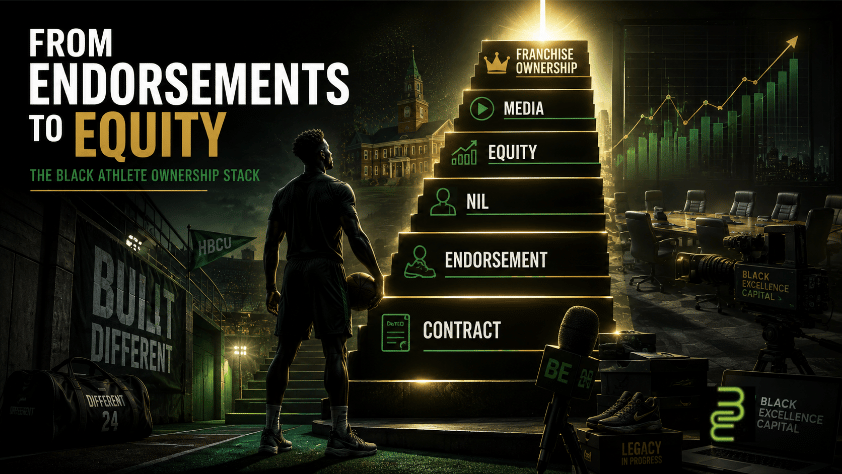
The ownership stack looks like this:
Contract.
The athlete is paid for labor and performance.
Endorsement.
The athlete is paid for influence and visibility.
NIL.
The athlete monetizes name, image, likeness, and audience value.
Equity.
The athlete participates in business upside.
Media.
The athlete controls storytelling, audience, content and distribution.
Franchise ownership.
The athlete moves from being labor inside the system to owning part of the system.
That ladder is where the future is headed.
Black Athletes Create More Than Sports Value
Black athletes do not only create value on the court or field.
- They move sneaker culture.
- They shape fashion.
- They drive TV ratings.
- They influence music, gaming, betting, media, and social platforms.
- They help colleges, leagues, apparel companies, broadcasters, and sponsors reach younger audiences.
- They turn attention into markets.
The Larry Miller and Air Jordan story showed one side of this economy: Black athletes and Black consumers can help create enormous brand value.
But the ownership question determines who captures the upside.
- Who owns the shoe company?
- Who owns the team?
- Who owns the media rights?
- Who owns the production company?
- Who owns the data?
- Who owns the audience relationship?
- Who benefits when Black athletic excellence becomes global culture?
Those questions matter because visibility is not the same as control.
The College Sports Layer Makes This Bigger
The ownership question does not stop with professional athletes.
College sports has its own version of the same economic tension.
Black athletes help power major revenue systems inside universities, conferences, media contracts, sponsorship deals and fan economies. Yet many of the communities that produce that talent do not control the institutions or revenue streams built around it.
That is why the NAACP’s call around Black athletes and SEC-state schools raised a bigger issue than representation alone.
It pointed to the economic leverage of Black athletic labor.
When institutions profit from Black athletes while political and economic conditions harm Black communities, the question is not just who gets recruited.
The question is who gets protected, who gets paid, and who gets power.
Rich Paul’s Message Is Really About Capital Allocation
Rich Paul’s warning is powerful because it brings the conversation down to a practical level.
What happens after the contract is signed?
- Does the money become lifestyle?
- Does it become emergency support for everyone around the athlete?
- Does it disappear into status symbols?
- Or does it become ownership?
That is capital allocation.
For a young athlete, the difference between consumption and ownership may not feel urgent in the moment. But over time, it becomes everything.
Money spent on temporary status usually has to be earned again.
Money converted into assets can keep producing.
That is why the private jet line matters. It is not really about flying commercial. It is about whether the athlete is using peak income to perform success or to build control.
Wealth Management Is Not the Same as Ownership Strategy
Wealth management protects money.
Ownership strategy builds power.
Both matter.
A strong financial team can help athletes budget, invest, handle taxes, reduce risk, and avoid bad deals. But the larger opportunity is about moving beyond preservation into participation.
- Participation in companies.
- Participation in media.
- Participation in real estate.
- Participation in funds.
- Participation in franchises.
- Participation in the platforms that monetize sports culture.
That is where Black athletes can shift from being highly paid labor to becoming long-term owners.
The New Athlete Playbook
The old athlete wealth model was built around salary and endorsements.
The new model is broader.
It asks whether athletes can use their earning window to build a portfolio of assets that outlast their bodies, their playing time and their peak popularity.
That may include equity in consumer brands.
It may include production companies.
It may include podcasts, newsletters, or digital media platforms.
It may include real estate.
It may include venture funds.
It may include team ownership groups.
It may include licensing, IP, and storytelling rights.
The point is not that every athlete should become a venture capitalist.
The point is that every athlete should understand the ladder.
Contract income is the beginning.
Ownership is the destination.
Why This Matters for Black Economic Power
Black athletes are some of the most visible economic producers in American culture.
They generate revenue for leagues, owners, universities, apparel companies, networks, streaming platforms, advertisers, sports betting companies, and social media platforms.
But the upside does not automatically flow to the people creating the attention.
That is the economic issue.
If Black athletes create demand but do not own the brands, platforms, teams, media rights, or investment vehicles connected to that demand, then their wealth remains tied to performance and visibility.
Ownership changes that.
- It creates leverage after retirement.
- It creates income beyond the season.
- It creates institutional influence.
- It creates family and community wealth.
- It creates the ability to shape the next deal instead of only signing it.
The Real Lesson
Rich Paul’s comment should not be reduced to a debate about whether athletes should fly private.
That is the surface story.
The deeper story is about how Black athletes turn short-term income into long-term control.
The next era of athlete wealth will not be measured only by who signs the largest contract or lands the biggest endorsement.
It will be measured by who owns equity.
Who controls media.
Who builds brands.
Who buys into franchises.
Who protects the value they create.
Who moves from being marketed to becoming the market maker.
The lesson is not just spend less.
The lesson is own more.
Because in the Black athlete economy, getting paid is important.
But controlling the upside is the real power move.
A contract can make an athlete rich. Ownership can make an athlete powerful.
Shoot Your Shot
What is the real ownership question in Black sports: who gets paid, who gets protected, or who controls the upside?
Latest posts by normbond (see all)
- LeBron Took an $8 Million Deal. The 76ers May Capture the Bigger Economic Win. - July 24, 2026
- Lina Khan Is Entering New York City’s Development Machine. Who Gets the Land, Contracts, and Upside? - July 22, 2026
- If Workplace Race Data Disappears, Discrimination Becomes Harder to See—and Harder to Prove - July 22, 2026