


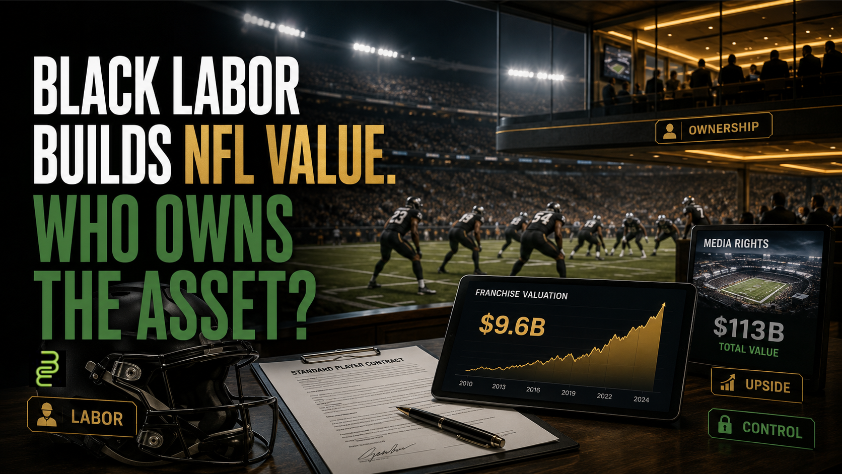
The Seattle Seahawks sale nearing a reported $9.6 billion is more than a sports business headline. It reveals how NFL value compounds through Black labor, media rights, fan loyalty and franchise ownership.
The Seattle Seahawks may be changing hands in one of the most expensive sports franchise transactions ever reported.
The Paul G. Allen estate has entered into a formal sale agreement with an ownership group led by the Khosla family.
The team said the Khosla family would become the controlling owner, while the terms of the transaction were not disclosed and the deal still requires NFL approval.
Reporting has placed the transaction near $9.6 billion, a number that would reset the NFL’s valuation conversation.
That number is the headline.
The economics behind it are bigger.
This sale converts decades of franchise appreciation, media-rights growth, public attention, fan spending, stadium economics and player labor into a multibillion-dollar private asset transfer.
It also arrives as the NFL faces renewed scrutiny over who gets access to leadership and control.
According to ESPN, New England Patriots passing game coordinator and tight ends coach Thomas Brown recently addressed the league’s hiring process after an offseason in which 10 head coaching positions opened and none were filled by a Black candidate.
“It’s a very complex conversation, something that has been a consistent dialogue almost every single year. To say it’s frustrating in some ways is probably an understatement,” Brown told ESPN.
Taken together, the Seahawks sale and the coaching pipeline debate point to the same economic question:
Who gets paid to produce NFL value, and who gets to control the assets that value creates?
The Seahawks Sale Is a Balance-Sheet Event
Sports coverage often treats franchise sales as scoreboards for billionaires.
This one should be read differently.
The Seahawks are not only a football team. They are a media asset, a local identity asset, a sponsorship platform, a stadium-linked business, a licensing vehicle and a scarce piece of NFL ownership.
That scarcity is why a franchise can approach a reported $9.6 billion valuation.
The team’s value did not come from one source.
It was built through national television deals, leaguewide revenue sharing, brand loyalty, ticket demand, corporate sponsorships, merchandise, digital attention and the cultural power of football in American life.
It was also built through labor.
The players generate the product people watch. Coaches help organize and develop that product. Stadium workers, media crews, trainers, medical staff, security teams, concession workers and local businesses support the machine around it.
But the compounding upside flows through ownership.
That is the distinction this sale makes visible.
Compensation Is Not the Same as Ownership
NFL players can earn significant money. Some become wealthy. A smaller number convert their visibility into businesses, investments, media careers or brand ownership.
But even high compensation is different from controlling equity.
A player’s earnings depend on draft position, contract timing, health, performance, roster decisions and career length. The average NFL career is short. Injury risk is real. Future earnings can change in a single play.
Franchise ownership works differently.
Owners benefit from scarcity, media-rights growth, league expansion, brand power and long-term appreciation. They do not have to take a hit on Sunday to benefit from the asset’s rising value.
That is the economics behind the Seahawks story.
Players help create the spectacle.
Owners hold the appreciating asset.
Black Labor Builds Much of the NFL Product
The NFL’s product is built substantially through Black athletic labor.
Black players are central to the speed, skill, physical risk and cultural influence that make the league one of the most valuable entertainment properties in the world.
That does not mean players are powerless. NFL players have a union, collective bargaining rights and the ability to negotiate compensation, benefits and workplace protections.
But players do not participate directly in franchise appreciation.
They are paid through contracts.
Owners capture equity value.
That difference matters for Black economic development because it mirrors a broader pattern across sports, music, entertainment, fashion, media and technology.
Black talent often creates the culture that drives value. But the largest long-term returns usually go to whoever owns the platform, catalog, franchise, data, distribution system, licensing rights or equity.
The Seahawks sale puts that pattern on a $9.6 billion scoreboard.
The Coaching Pipeline Is Part of the Same Control Problem
Thomas Brown’s comments add another layer.
The issue is not only who plays.
It is also who gets hired to lead.
Brown questioned the idea that teams are simply choosing the most qualified candidates if the result almost always leaves Black coaches outside the top job.
“I’ve constantly heard this mantra the last six years in the NFL that people hire the most qualified candidates, which I hope is true and accurate,” Brown said. “But you’re also seeing almost every time that is never a Black coach. Which is frustrating.”
Brown also pushed back against the argument that there are not enough Black candidates in the pipeline.
“I do take issue with that, because I’ve been around some high-level great communicators, great connectors of people, at every stop I’ve been,” he told ESPN.
That is important because head coaching is not just a symbolic role.
Head coaches shape staff hiring, player development, organizational culture, game strategy, leadership pipelines and sometimes future front-office influence.
Ownership is the highest level of control.
But coaching is also a gate of control.
When Black athletes are central to the labor force but Black coaches remain underrepresented in top leadership roles, the structure becomes difficult to ignore.
Black talent is most consistently welcomed where it produces the product.
It is less consistently elevated where it controls the institution.
Who Captures the Upside?
The immediate upside of the Seahawks sale goes to the Allen estate, the incoming ownership group and the broader NFL ownership class.
A reported $9.6 billion transaction does not only affect Seattle.
It creates a new valuation benchmark for the league.
That benchmark can raise expectations for other franchises. It can strengthen the financial position of current owners. It can make NFL ownership even harder for new entrants to access.
That is how asset classes work.
One sale can reprice the room.
For the Khosla family, the Seahawks would represent more than a trophy asset.
The team would offer control of a scarce franchise inside a league with massive media power, national cultural relevance and durable revenue streams.
That is not ordinary wealth.
That is institutional access.
Who Carries the Risk?
Players carry physical risk.
They absorb injury risk, career-duration risk and the possibility that their earning window closes before they can fully capitalize on their labor.
Coaches carry career volatility risk.
Brown’s own career reflects that instability.
He has been part of successful organizations, interviewed for head coaching jobs, worked through unstable situations and still faces a hiring market where Black coaches continue to question whether the path to the top is applied equally.
Fans and taxpayers may carry another kind of risk.
A record franchise sale often raises future questions about stadium renovation, replacement, public financing, tax concessions or infrastructure support.
That does not mean a stadium fight is immediate in Seattle.
But communities have seen the pattern before: private franchise values rise, and later the public may be asked to support the infrastructure that helps those private assets generate revenue.
That is why sports ownership is not just a private business story.
It can become a public money story.
Why This Matters to Black Communities
This story is not about whether NFL players are paid well.
Many are.
The story is about the difference between income and ownership.
- Income pays for work.
- Ownership captures appreciation.
That distinction is central to Black wealth.
Across industries, Black workers, creators, athletes and consumers often help generate enormous value without controlling the assets that compound from that value.
In the NFL, the contrast is especially visible.
Black players help build the product.
Black coaches continue to fight for fair access to top leadership.
Black fans help power the audience.
But franchise ownership remains concentrated among a small ownership class.
The Seahawks sale makes the gap plain.
The people most visible in the product are not necessarily the people who own the product.
The Bigger Economic Lesson
The NFL is one of the clearest examples of how culture becomes capital.
- Games become broadcasts.
- Broadcasts become media rights.
- Media rights become franchise valuations.
- Franchise valuations become multibillion-dollar wealth transfers.
At every step, labor creates value.
But ownership determines who captures the compounding upside.
That is why the Seahawks sale should not be treated as just another rich-person transaction.
It is a case study in who controls the wealth created by Black labor, fan loyalty, public infrastructure and cultural attention.
The league’s hiring debate only sharpens the point.
If Black talent helps power the product on the field, and Black coaches still face barriers to top leadership off the field, then the ownership question becomes even more urgent.
Who gets to work inside the NFL economy?
Who gets to lead inside it?
And who gets to own the asset when the value multiplies?
The Economics Behind It
The reported Seahawks sale shows how modern sports wealth compounds through scarcity, media control, brand power and labor.
The Thomas Brown story shows how leadership access remains contested inside the same system.
Together, they reveal the core economic tension of the NFL:
Black labor is central to value creation, but Black control over ownership, leadership and long-term asset appreciation remains limited.
That is the story underneath the transaction.
Not just who bought the team.
Who built the value.
Who controls the asset.
And who captures the upside.
Latest posts by normbond (see all)
- Nairobi Won the 2029 World Athletics Championships. Now Comes the Ownership Test. - September 15, 2026
- Dangote Refinery IPO Opens. Africans Can Buy Shares—Dangote Keeps Control - September 14, 2026
- U.S. Lends Africell Nearly $100M. Africa Faces a Bigger Ownership Question - September 11, 2026