


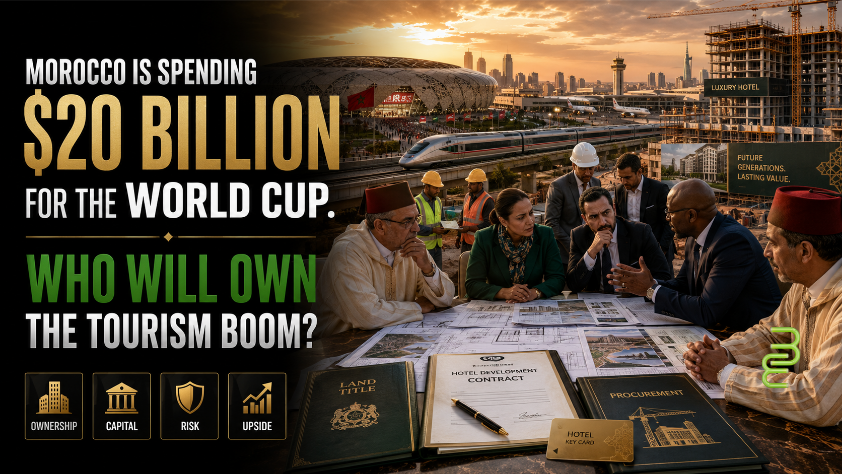
Morocco is preparing for the 2030 FIFA World Cup with more than stadium renovations.
The North African country plans to invest over 190 billion Moroccan dirhams—about $20 billion—in railways, roads, airports, stadiums and urban infrastructure.
It also intends to add 60,000 hotel beds, expanding its accommodation capacity by roughly one-fifth before it co-hosts the tournament with Spain and Portugal.
That makes this more than a sports story.
It is a large-scale effort to convert global attention into tourism revenue, property development, transportation capacity and long-term national growth.
The World Cup may provide the deadline and international spotlight. But Morocco’s economic strategy extends well beyond the final match.
The real question is not simply what gets built.
It is who will own what gets built—and who will collect the revenue after the crowds leave.
The World Cup is an economic accelerator
Morocco’s tourism minister, Fatim-Zahra Ammor, described the World Cup as an accelerator rather than an end in itself.
That distinction matters.
Major sporting events are often presented as one-time celebrations.
Governments justify spending by emphasizing international visibility, visitor demand and job creation. Morocco is framing the tournament as a way to accelerate infrastructure and tourism projects that support a broader development strategy.
The World Cup may provide the deadline, but ownership will determine whether the tourism boom builds lasting Moroccan wealth.
The country welcomed 19.8 million tourists in 2025, a 14% increase from the previous year, and is targeting 26 million annual visitors by 2030. Tourism contributes about 7% of Morocco’s gross domestic product and provides employment and foreign-currency revenue.
Morocco has already added approximately 45,000 hotel beds over four years, bringing national capacity to more than 300,000. The planned addition of another 60,000 beds would create a much larger commercial base for hotel operators, property owners, booking platforms, restaurants and transportation providers.
The government is also trying to expand tourism beyond established destinations such as Marrakech and Agadir. Rabat is being positioned for cultural, sports and business travel, while additional air connections are expected to target visitors from China, the United States and the Middle East.
This is a national growth strategy built around mobility, accommodation and international demand.
Where the money is moving
The $20 billion infrastructure figure stretches across several connected industries.
Public capital is moving into airport capacity, rail links, roads, stadiums and urban improvements. Private and institutional capital is likely to follow into hotels, restaurants, retail developments, entertainment venues, short-term rentals and commercial real estate.
Morocco’s airport strategy alone calls for national passenger capacity to rise from roughly 30 million to 80 million by 2030. A government agreement covering 2025 through 2030 assigns 38 billion dirhams to airport development, including a new international airport in Casablanca and expansions in seven World Cup host cities.
The country is also extending transportation networks and expanding stadium capacity. Earlier plans included high-speed rail expansion toward Marrakech, the renovation or expansion of 45 stadiums and training sites, and a proposed 115,000-seat stadium near Casablanca.
Each project creates several layers of economic opportunity:
- Construction companies can win public contracts.
- Landowners can benefit from rising property values.
- Hotel operators can collect recurring room revenue.
- Airlines can gain new passenger traffic.
- Restaurants, retailers and entertainment businesses can serve a larger visitor market.
- Digital travel platforms can collect booking fees and customer data.
The economic value will not be limited to World Cup ticket sales. It will be embedded in the infrastructure and commercial assets surrounding the event.
Ownership will determine who captures the upside
Job creation is important, but employment and ownership are not the same thing.
A Moroccan worker may earn wages constructing a hotel without owning any part of the property. A local restaurant may gain customers while an international platform collects fees on each booking. A city may attract millions of visitors while the largest returns flow to hotel groups, airlines, developers and financial institutions headquartered elsewhere.
That is why the ownership structure deserves as much attention as the construction totals.
Key questions include:
- Who receives the hotel-development licenses?
- Who owns the land near new transportation routes and stadium districts?
- Which companies receive construction and procurement contracts?
- Will local businesses gain access to commercial space?
- Who controls hotel operations, booking systems and customer data?
- Will Moroccan pension funds, entrepreneurs and community investors hold equity in the new assets?
- Will domestic companies become owners—or primarily vendors and subcontractors?
The difference will shape how much of the World Cup-driven wealth remains inside Morocco.
Public investment creates private opportunity—and public risk
The Moroccan government controls the infrastructure strategy, tourism policy and major project approvals. Taxpayers and public institutions therefore carry much of the initial development risk.
The commercial upside, however, may be distributed differently.
Private hotel companies, developers, airlines and investors can gain recurring revenue from publicly financed transportation and urban improvements. Better airports and railways make privately owned hotels and commercial properties more valuable.
This does not automatically make the investment a bad deal. Infrastructure can improve daily life, reduce travel times, expand commerce and strengthen national productivity.
But the public deserves a clear accounting of who receives the contracts, concessions and long-term operating rights.
The financing structure matters as well.
The African Development Bank approved a €270 million loan in 2025 to support Moroccan airport upgrades, part of a broader airport investment program. Loans can accelerate development, but they also create repayment obligations that remain after the tournament.
The central question is whether the resulting assets generate enough broad and lasting value to justify the public cost.
Workers can gain jobs without gaining wealth
Construction, tourism and hospitality expansion can create thousands of jobs.
But the quality and durability of those jobs will matter.
World Cup-related construction employment may disappear after major projects are completed. Hospitality positions may remain, but wages, working conditions and advancement opportunities will determine whether tourism growth produces economic security.
Temporary labor demand is not the same as long-term wealth creation.
Morocco can increase the local payoff by connecting infrastructure spending to apprenticeships, skilled-trade development, domestic procurement and pathways for Moroccan companies to become prime contractors rather than remaining at the bottom of subcontracting chains.
Local ownership in hotels, restaurants, transportation services and tourism technology would allow workers and entrepreneurs to participate in the recurring revenue created after 2030.
Without that layer, workers may help build the tourism economy without owning a meaningful share of it.
Residents may carry costs that visitors do not see
Large tourism and infrastructure projects can raise nearby land and housing values.
That benefits existing property owners. It can also increase rents, encourage speculation and displace lower-income residents.
Host cities may experience congestion, construction disruption and public-space changes. Government priorities can also shift toward visitor corridors, stadium districts and premium developments while neighborhoods with less tourism potential wait for basic improvements.
Official statements describe the World Cup as a broader development lever intended to improve transportation, healthcare, public facilities and local economic activity beyond host venues.
Whether those benefits reach communities outside the most commercially valuable areas will be an important measure of success.
The question is not whether infrastructure should be built.
It is whether residents receive benefits proportional to the costs and disruption they absorb.
Why this matters across the Black world
Morocco’s strategy illustrates how African sports success can be converted into tourism, infrastructure and national-brand value.
The country’s historic 2022 World Cup performance expanded its global visibility. Hosting in 2030 offers another opportunity to transform attention into investment and recurring revenue.
But attention alone does not create shared wealth.
African countries frequently supply the culture, labor, land, natural resources and consumer markets behind global economic opportunities. Outside investors and multinational companies often hold the financing, platforms, brands or distribution systems that capture the largest returns.
The 2030 World Cup creates an opportunity for Morocco to change that pattern.
Domestic ownership, transparent procurement, local capital participation and support for Moroccan businesses could turn the tournament into a long-term asset-building project.
A weaker outcome would leave the public carrying debt and disruption while outside capital owns much of the hospitality and commercial infrastructure.
Morocco is not simply preparing to welcome football fans.
It is building an expanded tourism economy.
The lasting score will be determined by who owns it.
Lesson for Global Black Communities
The story offers a larger lesson for African and Black communities worldwide: cultural visibility and major events create value, but ownership determines where that value accumulates.
The opportunity is not merely to host global audiences.
It is to own the hotels, land, transportation services, media rights, customer relationships and businesses that monetize those audiences.
Ownership question
Will Moroccan businesses and investors own a meaningful share of the hospitality and commercial assets—or mainly provide labor and services to properties controlled by larger outside investors?
Latest posts by normbond (see all)
- Porsha Williams’ Fibroid Emergency Points to a Bigger Economic Cost for Black Women - September 19, 2026
- MACRO Bought ALLBLK. The Bigger Prize Is the Direct Relationship With Black Viewers. - September 18, 2026
- Kaepernick Says Jay-Z Gave the NFL Something It Couldn’t Own: Black Cultural Legitimacy - September 18, 2026