


The proposed offering could give African investors access to one of the continent’s largest industrial assets. The bigger question is how much ownership, voting power and long-term upside the public will actually receive.
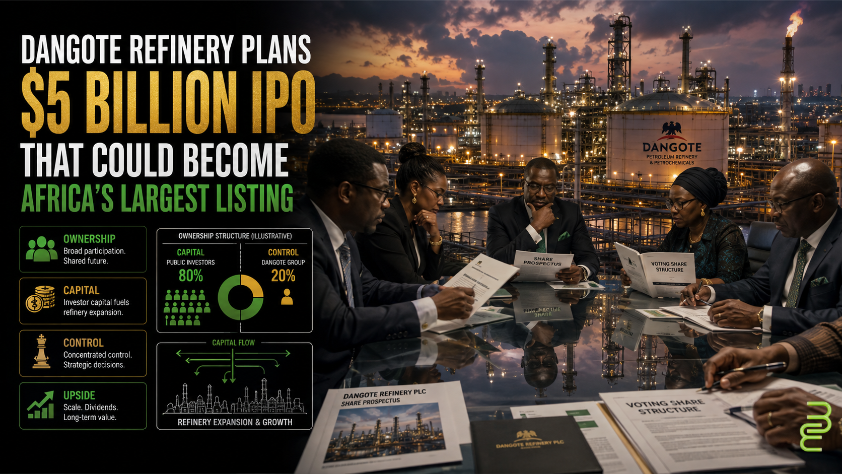
Dangote Petroleum Refinery is preparing a proposed $5 billion initial public offering that could become the largest public listing in African history.
The company has made an initial regulatory filing in Nigeria, with the offering expected to support a major expansion of its refining capacity. Final terms, including the size of the public stake and the timing of the listing, remain subject to regulatory approval and the publication of a formal prospectus.
The primary listing would take place in Nigeria. Other African markets are also exploring ways to give their investors exposure to the shares.
That makes this more than a fundraising story.
It could transform one of Africa’s largest privately controlled industrial assets into a continent-wide public investment platform.
But public participation does not automatically mean public control.
Where the Money Is Moving
The Dangote refinery currently has the capacity to process 650,000 barrels of crude oil per day.
The company has stated a goal of expanding that capacity to 1.4 million barrels per day. The proposed IPO would help finance that growth and strengthen Dangote’s position in refining, petrochemicals and regional fuel exports.
The company has also discussed plans for another major refinery in Kenya, although the final use of IPO proceeds will not be clear until the prospectus is released.
The money could come from African pension funds, institutional investors and individual shareholders looking for exposure to one of the continent’s most significant industrial assets.
For Dangote, the offering provides access to equity capital without relying entirely on additional debt or selling control to a foreign strategic buyer.
For Nigeria, the listing could create a much larger publicly traded company, deepen the domestic capital market and support expanded fuel-processing capacity.
For African investors, it could offer access to an industry that has historically required enormous amounts of capital and has often remained outside the reach of ordinary shareholders.
Who Will Own the Refinery?
Aliko Dangote remains the controlling owner of the refinery.
Nigeria’s state-owned NNPC holds slightly more than 7%.
The percentage of the refinery that will be offered to the public has not been disclosed.
That is one of the most important unanswered questions.
Nigeria’s main stock exchange generally requires listed companies to maintain a minimum public float of 20%, but exceptions have been granted in the past, including to Dangote Cement.
A $5 billion raise does not necessarily mean the public will own a large percentage of the refinery.
The actual ownership share will depend on the final valuation, the number of shares sold and the rights attached to those shares.
A recent private placement reportedly implied a valuation near $40 billion.
That valuation would place the refinery above several publicly traded refiners with comparable capacity. Investors may be asked to price in future growth, regional market power and expansion plans that have not yet been fully delivered.
That creates both opportunity and risk.
Capital Participation Is Not the Same as Control
The proposed IPO could broaden the refinery’s investor base while leaving governance power highly concentrated.
Public shareholders may receive access to dividends and future share-price appreciation.
But that does not automatically mean they will have meaningful influence over the board, expansion strategy, pricing decisions or distribution priorities.
The formal prospectus should clarify:
- How much of the refinery will be publicly owned.
- Whether public investors will receive voting shares.
- Whether any shareholder will retain special voting rights.
- How directors will be appointed.
- How dividends will be paid.
- What protections minority investors will receive.
- Whether investors outside Nigeria will hold direct shares or indirect financial instruments.
These details will determine whether the IPO creates meaningful ownership or mainly provides expansion capital.
Direct Shares or Indirect Exposure?
The offering is being presented as a potential pan-African capital event.
Investors in markets including South Africa, Kenya, Egypt, Ghana and Rwanda may seek exposure to the refinery.
However, investors outside Nigeria may not receive the same type of ownership as investors who buy shares directly on the Nigerian exchange.
Some may gain exposure through depositary receipts, exchange-traded products or other instruments tied to the underlying shares.
Those products may provide access to dividends and market gains.
They may also provide weaker voting rights, additional fees, currency exposure or less direct influence over corporate decisions.
That distinction matters.
An investor can gain financial exposure to an asset without gaining meaningful governance power over it.
Who Captures the Upside?
Dangote and existing shareholders could benefit from fresh capital, greater liquidity and a publicly established valuation.
The IPO could also allow the company to expand without giving up control to an outside industrial buyer.
African pension funds, institutions and households could gain exposure to refining, petrochemicals, fuel exports and future capacity growth.
Nigeria could benefit from a larger public-market asset, expanded domestic processing and increased investor attention.
Other African financial markets could gain access to one of the continent’s most recognizable industrial companies.
If the refinery expands successfully and produces strong earnings, public shareholders could benefit through dividends and share-price appreciation.
But those gains will depend on the price investors pay and the rights they receive.
Who Carries the Risk?
Public investors will carry valuation, operational, currency and commodity-price risk.
The refinery must secure crude supplies, manage a complex industrial operation, complete its expansion plans and compete in volatile energy markets.
If the public valuation is too high, investors may have limited room for error.
Pension funds could also place retirement capital into an asset exposed to oil prices, government policy, currency movements and operational disruptions.
Consumers face a separate risk.
The refinery could reduce Africa’s dependence on imported fuel and keep more refining activity on the continent.
But if one company becomes dominant in regional fuel supply, consumers, distributors and governments may become more dependent on its pricing and commercial decisions.
Public ownership does not automatically remove concentrated market power.
Why This Matters to Black Communities
This could become one of the largest Black-controlled industrial capital events ever attempted.
It would signal that African markets may be able to finance large-scale infrastructure and industrial development without relying entirely on capital from London, New York or other global financial centers.
It could also give African institutions and households an opportunity to own part of the infrastructure processing the continent’s resources and supplying its consumers.
But symbolic participation is not enough.
The economic value of the IPO will depend on whether investors receive transparent, enforceable and meaningful ownership rights.
The question is not simply whether Africans can buy shares.
The question is what those shares allow them to own, influence and benefit from.
- Will investors receive voting power?
- Will they share in future appreciation?
- Will they have meaningful minority protections?
- Will ownership be broadly distributed across African institutions and households?
- Or will the public mainly finance an expansion strategy that remains tightly controlled?
The prospectus will provide those answers.
Until then, the $5 billion headline should be viewed as the beginning of the ownership conversation—not the conclusion.
The Economics Behind It
The proposed IPO could turn a privately controlled refinery into a publicly priced African industrial asset.
That could deepen African capital markets, expand domestic refining and give more investors access to long-term industrial growth.
But raising capital from the public is not the same as distributing control.
The real measure of this offering will be the percentage sold, the voting structure, the governance rights and the type of ownership offered across African markets.
Participation is not the same as control.
The most important question is not whether the listing will make history.
It is whether that history includes a meaningful transfer of economic ownership.

Latest posts by normbond (see all)
- Beyoncé Funded Cécred Herself. Now the Real Test Is Global Distribution. - October 2, 2026
- Africa Doesn’t Own Most of the World’s AI. It Still Controls Something AI Companies Need: Access. - September 29, 2026
- Michael Jordan Gave Morehouse $1 Million. Now It Has a Media Production Center. - September 26, 2026