


The Los Angeles Lakers may have just produced one of the clearest ownership lessons in professional sports.
Joshua Kushner and former Disney CEO Bob Iger have reached an agreement to purchase the Lakers from Mark Walter in a transaction valuing the franchise at $12.5 billion. The deal still requires approval from the NBA’s Board of Governors.
That $12.5 billion headline is remarkable by itself. Reuters reports it would establish a new record for a team-sports transaction.
But the more revealing number may be the one sitting underneath it:
25%.
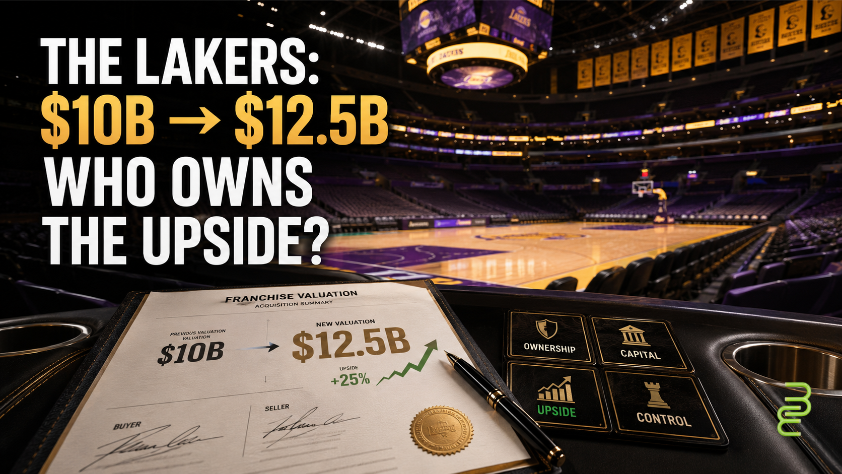
Walter acquired the controlling interest in the Lakers in a transaction valuing the team at $10 billion roughly 14 months ago. The new agreement puts the franchise at $12.5 billion — a $2.5 billion increase in implied total franchise value.
That does not mean Walter personally pocketed $2.5 billion. The economics depend on the stakes purchased and sold and the transaction structure.
What it does show is how quickly ownership of an elite sports franchise can appreciate.
And that raises the more important question:
Who owns the upside?
Draymond Green questions why the Lakers changed hands twice in 14 months amid reported loan investigations: “Something’s there for certain”
“The Lakers have officially been sold again only 14 months after being bought by Mark Walter.”
“They were sold to Josh Kushner and Bob… pic.twitter.com/SVK52j7DxO
— Isaac Bassey (@0xBassey) August 13, 2026
Sports teams are becoming scarce financial assets
Professional teams produce revenue from tickets, media rights, sponsorships, merchandise and other businesses.
But investors are increasingly paying for something larger: ownership of a scarce asset with limited supply and potentially expanding revenue streams.
There are only 30 NBA franchises.
Reuters reports that scarcity has become an important part of the economics driving professional sports valuations.
At the same time, U.S. television and streaming sports rights reached an estimated $29.5 billion in 2025, according to S&P Global data cited by Reuters, up from an estimated $14.64 billion a decade earlier. S&P Global projects those rights could reach $37 billion by 2030.
Live sports are particularly valuable because they can still command audiences in real time while much of the rest of entertainment has fragmented across platforms and on-demand viewing.
Then add sponsorships, merchandising, arena economics, global fandom and other potential revenue streams.
A franchise such as the Lakers is not merely a basketball operation.
It is an ownership position in a scarce global entertainment property.
The difference between creating value and owning value
This is where the Lakers deal becomes especially relevant beyond Los Angeles.
- Players produce the competition people pay to see.
- Fans supply attention, loyalty and cultural relevance.
- Media companies convert that attention into distribution and advertising economics.
- Sponsors pay for access to the audience.
But the franchise owner holds the equity.
That distinction matters because labor income and asset appreciation work differently.
An athlete can earn an extraordinary salary and endorsements. Those earnings can create enormous wealth.
But unless the athlete owns equity in an appreciating asset, the increase in that asset’s value belongs somewhere else.
In the Lakers’ case, the implied value of the franchise rose from $10 billion to $12.5 billion in roughly 14 months.
That appreciation accrues to the equity holders according to their ownership positions.
The players do not automatically receive a percentage of it because they played well.
Fans do not receive equity because they bought tickets, jerseys or streaming packages.
Cultural importance does not automatically become ownership.
That is the economics behind the headline.
Iger and Kushner are buying more than a basketball team
The incoming ownership pairing is also notable.
Iger spent decades at Disney, where his responsibilities included some of the most consequential media and entertainment assets in the world. Kushner built Thrive Capital and is entering the transaction from the investment and venture-capital side. AP reports the pair moved quickly after learning Walter was open to a sale.
That combination matters because the future economics of sports increasingly sit at the intersection of capital, media, technology and distribution.
An elite team generates games.
But ownership sits above an ecosystem of audience relationships, sponsorship inventory, intellectual property, media rights and brand extensions.
The question is not merely whether Iger and Kushner believe the Lakers can win championships.
At a $12.5 billion valuation, the economic question is what they believe the Lakers — and the NBA around them — can be worth next.
Walter’s sale also has a capital-allocation dimension
There is another layer worth watching.
Reuters reported separately that Walter’s TWG Global has been exploring transactions aimed at raising capital and restructuring loans held on the balance sheets of insurance companies Delaware Life and Clear Spring Life and Annuity. Reuters said Bloomberg reported those efforts continued after the Lakers sale agreement was reached; Reuters also noted it had not independently verified Bloomberg’s report.
That distinction matters.
BEDC does not claim the Lakers were sold because Walter needed liquidity. The available reporting does not establish that causal relationship.
But the surrounding financial activity makes the transaction worth watching as more than a sports story.
Assets can appreciate dramatically and still become sources of liquidity when owners decide capital has a more valuable use elsewhere.
Ownership creates that option.
Why this matters for Black economic development
The NBA provides a particularly visible case study in the relationship between labor, culture and ownership.
Black athletic talent has long been central to the league’s product and cultural reach. The broader economic lesson, however, extends far beyond basketball.
A person can be essential to creating value without owning the asset where that value ultimately accumulates.
That distinction appears across entertainment, music, technology, media and entrepreneurship.
Salary compensates labor.
Licensing monetizes intellectual property.
Revenue sharing distributes operating income.
Equity participates in appreciation.
Those are different mechanisms for building wealth.
That does not make ownership risk-free. Walter committed substantial capital when he acquired control of the Lakers. Iger and Kushner would be committing even more at the new valuation. Owners bear acquisition risk, operating risk and the possibility that future buyers will not assign the asset an even higher price.
The point is narrower.
When an asset rises 25% in implied value in roughly 14 months, the people holding equity are positioned to capture that appreciation.
The people whose labor and attention help make the asset valuable do not automatically participate in the same wealth mechanism.
The bigger ownership question
The Lakers transaction should therefore spark a conversation larger than whether $12.5 billion is too much to pay for a basketball team.
The more important question is what pathways exist for the people creating sports value to move from compensation into ownership.
That could mean athlete investment groups.
It could mean minority franchise stakes.
It could mean ownership of media, intellectual property, adjacent businesses and real estate connected to the sports economy.
It could also mean recognizing that high income and ownership are not interchangeable.
The proposed Lakers transaction provides an unusually vivid illustration.
Fourteen months ago, the franchise changed hands at a $10 billion valuation.
Now another group is prepared to value it at $12.5 billion.
- The games matter.
- The players matter.
- The audience matters.
But when the underlying asset appreciates, ownership determines who has a claim on that upside.
Economic implication: Professional sports franchises increasingly function as scarce appreciating assets sitting at the intersection of media, live attention, intellectual property and institutional capital.
Why it matters: Cultural contribution and high labor income can generate wealth, but neither automatically creates participation in asset appreciation. Equity does.

Latest posts by normbond (see all)
- The Atlanta Dream Built the Demand. The Arena Calendar Still Controls the Opportunity. - October 13, 2026
- Black-Founded Vurt Is Taking Vertical Video to TV. The Bigger Question Is Who Controls Distribution. - October 12, 2026
- Owning the Asset Is Not the Same as Controlling the System - October 10, 2026