


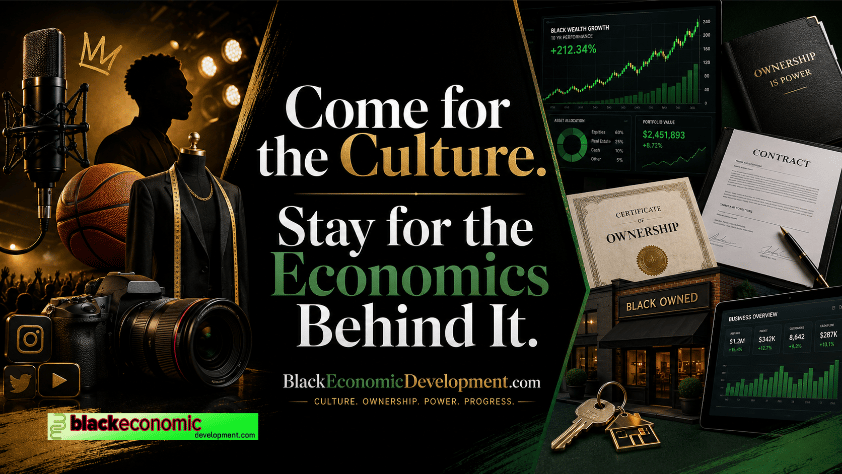
Come for the Culture. Stay for the Economics Behind It.
Black culture moves markets. BlackEconomicDevelopment.com explains who owns, funds, profits from and is exposed by that movement.
Black culture is never just culture.
- It is music.
- It is fashion.
- It is sports.
- It is media.
- It is labor.
- It is language.
- It is technology.
- It is influence.
- It is consumer power.
- It is political pressure.
- It is business opportunity.
- It is intellectual property.
- It is an economy.
For too long, stories about Black culture have stopped at visibility.
- Who went viral?
- Who got signed?
- Who got canceled?
- Who got the role?
- Who launched the brand?
- Who bought the house?
- Who got the deal?
Those questions matter. But they are not enough.
At BlackEconomicDevelopment.com, we are asking the next set of questions.
Who owns the platform?
Who controls the distribution?
Who captures the upside?
Who carries the risk?
Who owns the IP?
Who gets paid for the labor?
Who benefits from the data?
Who turns attention into assets?
And what does it mean for Black wealth, Black business, Black workers, Black creators, Black consumers, Black institutions and the Black diaspora?
That is the economics behind it.
Culture is the entry point
People may come here because of a celebrity story, a sports headline, a reality TV franchise, an AI debate, a policy change, a media deal, a business launch or a viral moment.
That is fine.
Culture gets people’s attention.
But attention is not the finish line.
Attention is the beginning of the economic question.
When a Black athlete signs an endorsement deal, the story is not only the brand campaign. It is equity, ownership, licensing, labor power and long-term wealth.
When a Black reality TV franchise dominates conversation, the story is not only the drama. It is who owns the format, footage, audience, archive and advertising value.
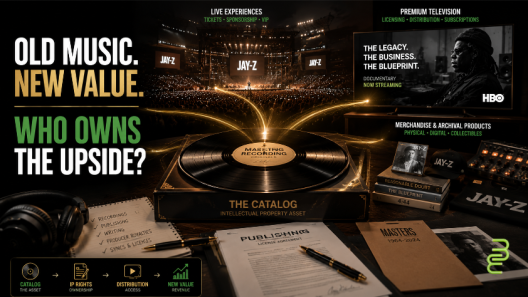
When a Black artist goes viral, the story is not only the song. It is publishing, masters, platform revenue, touring economics, merchandising and data.
When AI tools reshape work, the story is not only innovation. It is job exposure, business adoption, skills, automation, platform dependency and who gets left behind.
When policy changes, the story is not only Washington. It is the pocket-level impact on families, workers, small businesses, schools, cities, contracts and neighborhoods.
That is why we say:
Come for the culture. Stay for the economics behind it.
Visibility is not the same as power
Representation matters.
But representation without ownership has limits.
- A face on the screen is not the same as control of the studio.
- A viral post is not the same as ownership of the platform.
- A brand deal is not the same as equity.
- A job title is not the same as decision-making power.
- A seat at the table is not the same as owning the table.
Black culture has created enormous value across entertainment, sports, fashion, food, beauty, technology, politics and media. But too often, the systems that monetize that value are owned, financed, distributed and scaled by others.
That is the gap this platform exists to examine.
- Not with empty outrage.
- Not with shallow celebration.
- With economic interpretation.
The question is always ownership
Ownership is not just about who has a company.
It is about control.
- Who controls the land?
- Who controls the labor?
- Who controls the capital?
- Who controls the narrative?
- Who controls the algorithm?
- Who controls the audience relationship?
- Who controls the contract?
- Who controls the data?
- Who controls the distribution?
Ownership determines who benefits when culture becomes commerce.
It determines whether a moment becomes a movement.
It determines whether attention becomes wealth.
It determines whether a community is only represented in the marketplace or actually positioned to capture value from it.
That is why ownership will be a recurring question here.
Labor is part of the story
Black economic development is not only about founders, investors, celebrities and executives.
It is also about workers.
The people producing the culture.
The creators feeding the platforms.
The stylists, writers, editors, drivers, crew members, musicians, coders, nurses, teachers, organizers, athletes, service workers, freelancers, and entrepreneurs whose labor makes markets move.
A strong Black economy cannot be measured only by who becomes famous or who raises capital.
It must also ask who is protected, who is underpaid, who is automated, who is misclassified, who is excluded and who is expected to carry the risk while someone else captures the upside.
That is why this site will cover labor as seriously as it covers ownership.
Media is infrastructure
Media is not just content.
Media is infrastructure.
It shapes what people see, what they believe, what they buy, what they fear, what they aspire to and who they trust.
Black stories do not move through neutral systems. They move through platforms, networks, advertisers, algorithms, publishers, studios, creators and distributors.
That means media power is economic power.
- When Black audiences drive engagement, the question is who monetizes that audience.
- When Black creators build communities, the question is who owns the relationship.
- When Black culture trends, the question is who captures the revenue.
That is why media and distribution matter here.
Policy is personal
Policy can sound distant.
But policy always lands somewhere.
- It lands in mortgage approvals.
- It lands in school budgets.
- It lands in business loans.
- It lands in procurement contracts.
- It lands in hospital access.
- It lands in taxes.
- It lands in wages.
- It lands in student debt.
- It lands in infrastructure.
- It lands in neighborhood investment.
At BlackEconomicDevelopment.com, policy coverage will not stop at political theater.
The focus is policy to pocket: how decisions affect Black households, workers, founders, consumers, institutions and communities.
Technology is not neutral
AI and technology are already changing how people work, learn, hire, create, sell, borrow, diagnose, advertise and build.
That creates opportunity.
It also creates risk.
- Black businesses need access to tools that improve productivity.
- Black workers need skills that protect mobility.
- Black creators need to understand platform dependency.
- Black communities need to ask who owns the data and who benefits from automation.
The future of work is not a side issue.
It is a Black economic development issue.
What readers can expect
BlackEconomicDevelopment.com will cover the economics behind:
Celebrity business moves.
Sports ownership and athlete equity.
Reality TV and creator influence.
Black media ownership.
AI and work.
Policy-to-pocket impacts.
Black business signals.
Diaspora markets.
Culture-driven commerce.
Wealth and capital.
Entertainment, fashion, music, sports, technology, and politics will all appear here.
But they will not be treated as isolated moments.
They will be interpreted as signals.
- Signals about power.
- Signals about money.
- Signals about ownership.
- Signals about labor.
- Signals about who is building wealth and who is being used to create it.
The goal is clarity
This platform is not here to make every story sound bigger than it is.
It is here to make the economics clearer.
Some stories will reveal opportunity.
Some will reveal extraction.
Some will reveal risk.
Some will reveal ownership gaps.
Some will reveal power shifts.
Some will reveal how Black communities can build, protect, negotiate, invest, organize or compete differently.
That is the work.
To look underneath the headline.
- To separate visibility from leverage.
- To separate popularity from ownership.
- To separate culture from the systems profiting from it.
The promise
Black culture creates value.
BlackEconomicDevelopment.com explains where that value goes.
We are here for the culture.
But we are staying for the economics behind it.
Because the future of Black economic power will not be built by attention alone.
It will be built by ownership, infrastructure, labor protection, capital access, media control, business capacity, technological readiness and community wealth.
That is the story behind the story.
And that is why this platform exists.
Economic implication
Black culture is one of the most powerful value engines in the global economy, but value creation and value capture are not the same thing.
The money moves through platforms, media companies, advertisers, brands, investors, distributors, algorithms, institutions and consumers.
The central question is who owns the systems that convert Black attention, labor, creativity and trust into wealth.
Why it matters
For Black communities, the next stage of economic development cannot depend only on visibility.
It must focus on ownership, labor protection, capital access, media control, policy impact, technology readiness and durable wealth-building infrastructure.
Attention is not the finish line. Attention is the beginning of the economic question.
Over to You
What story made you realize Black culture is also an economy?
Latest posts by normbond (see all)
- Nairobi Won the 2029 World Athletics Championships. Now Comes the Ownership Test. - September 15, 2026
- Dangote Refinery IPO Opens. Africans Can Buy Shares—Dangote Keeps Control - September 14, 2026
- U.S. Lends Africell Nearly $100M. Africa Faces a Bigger Ownership Question - September 11, 2026