


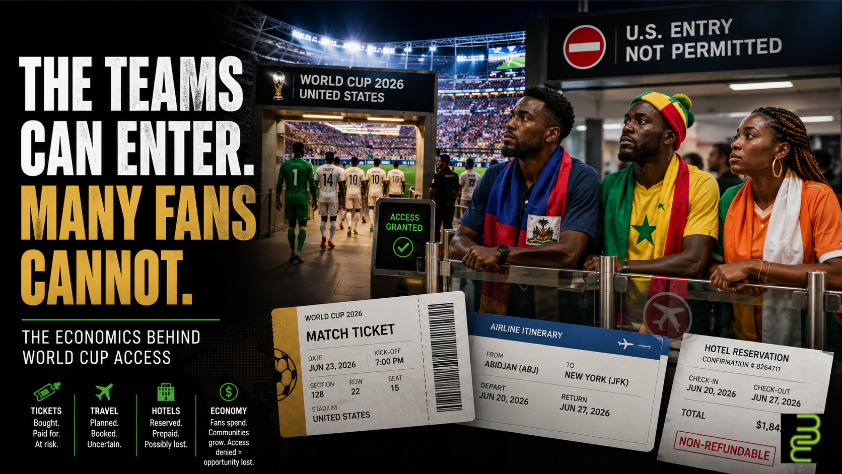
The World Cup can admit the teams without admitting many of the people who give those teams their cultural meaning.
Players, coaches, necessary support personnel and immediate relatives qualify for an exemption from U.S. entry restrictions when traveling for the World Cup or another designated major sporting event.
Ordinary supporters do not receive the same categorical protection.
That distinction affects fans from Haiti, Senegal and Côte d’Ivoire, whose national teams are competing while U.S. policy fully or partially restricts entry by nationals from their countries.
Haiti is covered by a full suspension. Côte d’Ivoire and Senegal are subject to restrictions that include the visitor-visa categories most supporters would ordinarily use.
This is more than an immigration story.
It is a story about who gets access to the World Cup economy, who controls that access and who carries the loss when public policy collides with a global commercial event.
The product can enter. Part of the audience cannot.
The presidential proclamation creates an explicit exception for athletes, team members, coaches, necessary support personnel and immediate relatives traveling for the World Cup.
It does not extend that blanket exception to regular ticket holders or supporters.
The economic structure is difficult to ignore.
The competitive labor enters the country. The matches proceed. Broadcast programming is produced. Sponsors receive exposure. Tickets retain commercial value.
But some of the consumers whose national loyalty helps create the tournament’s atmosphere, identity and demand remain excluded.
Reuters reported that supporters from affected countries have been unable to travel because of visa restrictions or denials. One Senegalese American supporter said he obtained a match ticket from a friend in Senegal who could not attend after failing to secure a visa.
The tournament therefore preserves the product while limiting part of the market around it.
Where the World Cup money moves
A World Cup visitor does not purchase only a seat.
The trip can include airfare, hotel rooms, local transportation, restaurant meals, merchandise, entertainment, mobile service and other spending across the host-city economy.
FIFA and its commercial partners control major revenue channels around ticketing, sponsorship, media rights and official hospitality. Host-city businesses capture additional spending after supporters arrive.
Entry policy determines who is allowed to participate in that spending system.
When a fan is prevented from traveling, the financial effects can spread across several markets:
- The supporter may lose money connected to tickets, flights or reservations.
- Airlines and travel providers may face cancellations, disputes or rebooking costs.
- Hotels and restaurants lose potential customers.
- Businesses in Haiti, Senegal and Côte d’Ivoire lose outbound tourism-related activity.
- Host cities receive less international visitor spending.
- Teams compete without the full supporter presence that makes international football commercially distinctive.
The loss does not necessarily disappear. It moves from one party to another.
FIFA places visa risk on the supporter
FIFA’s published guidance says that holding a World Cup ticket does not guarantee a visa or admission to a host country.
More importantly, FIFA states that a ticket holder who fails to obtain the necessary visa or is denied entry is not entitled to compensation from FIFA Ticketing.
That provision transfers much of the immigration risk to the consumer.
A fan may pay for a ticket to an event that cannot be reached because the host government will not issue the travel authorization typically needed to attend.
Yet the tournament organizer does not automatically accept responsibility for the ticket loss.
This does not mean every affected supporter loses the full purchase price. Some may be able to resell tickets through authorized channels, use travel insurance, obtain refunds from individual vendors or dispute eligible charges.
But those remedies depend on separate contracts and policies. They are not the same as a universal consumer guarantee.
The key policy-to-pocket question is therefore straightforward:
When a government restriction prevents a ticket-holding supporter from reaching the tournament, why should the fan bear most of the financial risk?
National pride is being monetized unevenly
International football sells more than competition.
It sells flags, identity, belonging, memory and national pride.
Supporters help create the emotional product that broadcasters show, sponsors attach themselves to and tournament organizers monetize. Their songs, clothing, celebrations and loyalty turn a match into a global cultural event.
Yet the populations producing that value do not always receive equal access to the commercial experience built around it.
Reuters reported that Haiti’s larger U.S.-based diaspora can provide some in-stadium support. Senegal and Côte d’Ivoire have smaller domestic communities available to fill the gap created by absent traveling fans.
Diaspora supporters may organize watch parties, patronize restaurants, buy merchandise and generate local activity. That creates an opening for Haitian, Senegalese, Ivorian and other Black-owned businesses in U.S. host cities.
But diaspora substitution is not a complete economic remedy.
It does not reimburse the supporter abroad who purchased a ticket, planned a trip or expected to follow the national team. Nor does it replace spending that would have flowed through travel agencies, airlines, restaurants and tourism businesses in the fan’s home country.
Who controls the asset—and who absorbs the risk?
Several institutions control different parts of the World Cup experience.
FIFA controls the tournament, ticketing system and core commercial rights.
The U.S. government controls admission into the country.
Airlines, hotels, insurers and booking platforms control many of the refund and cancellation terms.
Stadium operators, sponsors and local hospitality businesses control much of the spending environment once fans arrive.
The supporter controls very little beyond the decision to purchase.
That imbalance matters because the parties capturing the largest commercial upside are not necessarily the parties bearing the greatest individual risk.
FIFA can stage the match even when some overseas supporters cannot attend.
Broadcasters can still sell the spectacle.
Sponsors can still associate themselves with national teams and global fandom.
A restricted fan, however, may be left with a ticket, a denied visa and a series of vendors pointing to separate terms and conditions.
Why this matters to Black communities
For Black communities, this story reveals a familiar economic divide.
Black identity, national pride, athletic labor and cultural expression can remain commercially valuable even when Black populations face barriers to participation, mobility or ownership.
The teams are necessary because they produce the competition.
The cultures are necessary because they produce the meaning.
The fans are valuable because they create demand.
But access is controlled elsewhere.
That is the deeper economics behind the World Cup restrictions: African and Haitian identity can be marketed globally while some African and Haitian consumers are prevented from entering the marketplace constructed around it.
Black communities should also watch where displaced fan spending moves.
U.S.-based diaspora restaurants, bars, event producers, travel professionals and retailers could capture demand through official-feeling but independently owned fan experiences.
Watch parties and cultural events can create revenue opportunities, particularly when they are organized by businesses connected to the represented communities.
That opportunity should not distract from the underlying policy question.
It shows how communities adapt after access has already been restricted.
What FIFA should have anticipated
A global tournament hosted across countries with different immigration systems will always carry travel risk.
But restrictions covering participating nations create a foreseeable consumer-protection problem.
That raises questions about what FIFA negotiated before awarding and staging matches in the United States:
- Did the hosting framework require protections for supporters from qualifying countries?
- Was there a refund mechanism for ticket holders affected by later government restrictions?
- Were ticket purchasers clearly warned before payment that policy could make attendance impossible?
- Can affected supporters transfer or resell tickets without additional financial loss?
- Should ticket revenue be held or refunded when entry is blocked because of nationality-based policy rather than an individual supporter’s conduct?
FIFA has emphasized that a ticket does not guarantee admission to a host country.
That may disclose the legal risk.
It does not resolve whether the risk has been allocated fairly.
The economics behind it
The World Cup’s commercial model depends on movement: athletes moving between venues, media moving across platforms and supporters moving across borders.
When governments interrupt one part of that movement, the effects reach far beyond immigration policy.
They change who can buy, travel, gather, spend and participate.
They also expose the hierarchy inside the tournament business.
The labor is admitted.
The content is produced.
The rights holders are paid.
The audience carries the uncertainty.
That is why the most important question is not merely whether the teams can take the field.
It is who pays when the people who made those teams culturally valuable cannot enter the country to watch them.
Economic implication
U.S. entry restrictions reduce the pool of international consumers able to spend within the World Cup economy while leaving the tournament’s core commercial structure intact.
The rules separate the labor and content required to stage the event from some of the supporters expected to finance the surrounding tourism and hospitality activity.
FIFA’s stated policy places visa and admission risk primarily on ticket holders rather than guaranteeing compensation when travel becomes impossible.
Ownership question
Who should bear the financial loss when government policy prevents a ticket-holding supporter from entering the host country: the fan, FIFA, airlines, booking companies, insurers or the host government?
Who captures the upside
FIFA, broadcasters, sponsors, ticketing and hospitality partners, hotels, restaurants and other host-city businesses remain positioned to capture tournament revenue.
U.S.-based Haitian and African diaspora businesses may also benefit by organizing watch parties, cultural events, food experiences and merchandise opportunities for supporters unable to travel with their national communities.
Who carries the risk
Restricted supporters face the most direct risk through unusable tickets, disrupted travel and nonrefundable reservations.
Small tourism businesses in the affected countries may lose customer spending. Teams risk reduced supporter presence, while host cities lose some of the international spending the tournament was designed to attract.
Why it matters
This case shows how Black culture and national identity can remain fully marketable while Black consumers face restricted access to the market.
It also demonstrates why major sporting-event agreements should be examined not only for stadium construction and sponsorship rights, but for mobility, refunds and consumer protection.

Latest posts by normbond (see all)
- Who Owns the Upside From Power? 50 Cent’s Variety Interview Reveals a Bigger TV Economics Story - October 20, 2026
- Burkina Faso Rejected a U.S. Deportation Deal. Then the Fight Moved to Visa Access. - October 19, 2026
- NC A&T Students Marched 45 Minutes to Vote. The Bigger Story Is Who Controls Access. - October 17, 2026