


A federal lawsuit against Workday raises a larger economic question: Who is accountable when automated screening limits access to jobs, wages, and career mobility?
A federal judge has ruled that Workday must face claims alleging that its AI-powered hiring software screened applicants in ways that violated California law and the Americans with Disabilities Act.
The plaintiffs also allege discrimination against Black job seekers, women, and applicants over 40. The ruling does not establish that Workday discriminated. It allows significant parts of the case to continue.
Workday denies the allegations.
The company says its recruiting technology evaluates job qualifications rather than protected characteristics and does not make final hiring decisions. It also says it tests its products through a Responsible AI program.
The lawsuit is about more than one software company.
It is testing who controls—and who is responsible for—the increasingly automated infrastructure connecting workers to employment.
Hiring software controls access to income
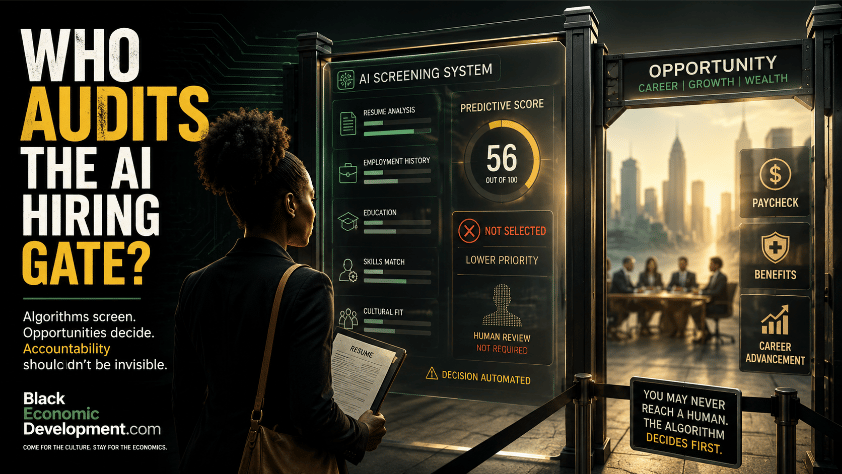
A hiring platform may look like an administrative tool. Economically, it operates closer to a gate.
The people who pass through that gate can gain access to wages, health insurance, retirement benefits, promotions, professional networks and future earning power.
The people screened out may never know why they were rejected—or whether a human recruiter ever saw their application.
That makes algorithmic hiring different from a single manager making one potentially biased decision. A digital screening system can apply the same criteria across thousands or millions of applications.
When the system works as intended, employers can process large applicant pools more quickly and reduce recruiting costs.
When the system contains discriminatory patterns, the potential harm can also scale.
The economics are therefore straightforward: companies capture the efficiency while applicants carry much of the risk.
Workday and employers share control of the gate
The central ownership question is not simply who owns the software.
It is who controls the decision trail.
Workday builds and operates the platform. Employers purchase and deploy the technology within their hiring processes. Applicants provide résumés, employment histories and other personal information, often without a clear understanding of how automated tools will evaluate them.
That distribution of control can make accountability difficult.
A software vendor may argue that the employer makes the ultimate decision. An employer may argue that it relied on a vendor’s technology. Meanwhile, the rejected applicant may lack access to the scoring criteria, model outputs, internal audits or data needed to challenge the result.
A previous ruling in the litigation allowed claims to proceed on the theory that Workday could potentially operate as an agent of the employers using its tools. That issue matters because companies may not be able to avoid responsibility merely by placing automated screening between themselves and applicants.
The data problem is also an ownership problem
Algorithmic systems do not need to use race explicitly to produce unequal outcomes.
The lawsuit alleges that screening systems may rely on proxy indicators, including gaps in employment history, that could disadvantage people with disabilities or illnesses. The plaintiffs separately allege discrimination based on race, gender and age.
Similar concerns arise when systems evaluate ZIP codes, educational histories, job titles, employment continuity or other variables correlated with unequal access to opportunity.
This turns applicant data into a source of economic power.
Employers and technology companies can use that data to rank workers, predict suitability and manage labor costs. Applicants, however, generally do not own the scoring systems or control how their histories are interpreted.
They may not even know that an automated recommendation contributed to their rejection.
The imbalance is clear: workers supply the data, but institutions own the analytical machinery that determines what the data means.
Why this matters for Black workers
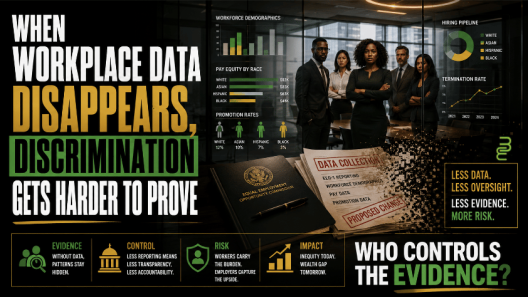
For Black applicants, hiring discrimination is closely tied to the larger racial wealth gap.
Employment determines more than a paycheck. It influences access to employer-sponsored health coverage, retirement contributions, homeownership, creditworthiness and the ability to build assets over time.
A 2026 résumé-audit study covering more than 36,000 applications found substantial callback disparities in some occupations, with subjective evaluation widening several demographic gaps.
The researchers concluded that early exclusion from higher-return jobs could reinforce long-term disparities in employment outcomes.
Automating parts of hiring does not automatically remove those inequalities.
It may standardize decisions, reduce some forms of individual discretion and make evaluation more consistent. But it can also reproduce historical patterns through data, design choices or employer-defined criteria.
The economic threat is not that every AI system will discriminate in the same way.
It is that a flawed system can quietly deny opportunity at a scale that individual bias rarely reaches.
For Black workers, that could mean exclusion from career tracks that generate higher wages, stronger benefits and greater intergenerational wealth.
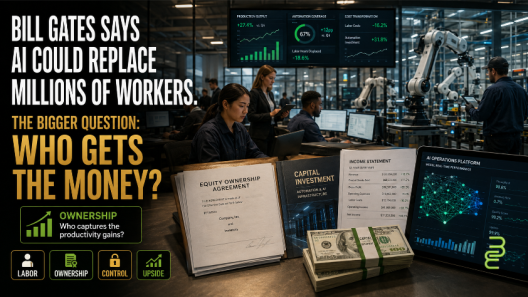
Who captures the upside?
Workday and other HR technology companies can generate revenue by selling employers speed, scale and workforce analytics.
Employers can reduce the labor required to review applications and move candidates through recruiting pipelines.
Human-resources departments can manage far larger applicant pools without expanding staff at the same rate.
Those are real economic benefits.
But the efficiency calculation is incomplete when the costs of errors fall primarily on applicants.
A worker incorrectly screened out loses an opportunity. The employer may never discover that a qualified candidate was removed. The software company may not encounter a visible consequence unless a regulator, court or audit uncovers a pattern.
This creates a familiar technology-market problem: the party making the purchasing decision is not necessarily the party carrying the greatest risk.
Auditing the gate
The Workday case could help shape the responsibilities of software vendors and employers when automated systems contribute to employment decisions.
The eventual legal outcome remains unresolved. But the economic issue is already visible.
AI hiring systems are becoming privately controlled infrastructure for access to work.
That infrastructure needs more than broad assurances of fairness. It requires clear responsibility, meaningful testing, accessible records and a way for workers to contest consequential decisions.
Employers should know which automated tools are being used, what factors they evaluate and whether outcomes differ across protected groups.
Vendors should be able to explain how their products are tested and who can access the relevant audit trail.
Applicants should receive meaningful notice when automation materially affects whether they advance.
Without those protections, the labor market may become more efficient for institutions while becoming less transparent for workers.
The key question is no longer whether AI will participate in hiring.
It is whether the people controlling the gate will also own the consequences.
Economic implication
AI hiring software is becoming part of the infrastructure that allocates access to wages and career mobility. Vendors and employers capture savings from automation, while applicants can bear the economic cost of errors, biased proxies and decisions they cannot inspect or appeal.
Ownership question
Who owns and is accountable for the decision trail when an AI hiring system prevents a qualified worker from being seen by a human recruiter?
The deeper issue is whether accountability belongs to the vendor that designs the system, the employer that deploys it, or both.
Why it matters
For Black workers, automated exclusion can compound existing disparities in employment, income and wealth.
A biased manager can harm individual applicants. A biased or poorly governed platform can reproduce exclusion across entire hiring pipelines.

Latest posts by normbond (see all)
- Who Owns the Upside From Power? 50 Cent’s Variety Interview Reveals a Bigger TV Economics Story - October 20, 2026
- Burkina Faso Rejected a U.S. Deportation Deal. Then the Fight Moved to Visa Access. - October 19, 2026
- NC A&T Students Marched 45 Minutes to Vote. The Bigger Story Is Who Controls Access. - October 17, 2026