



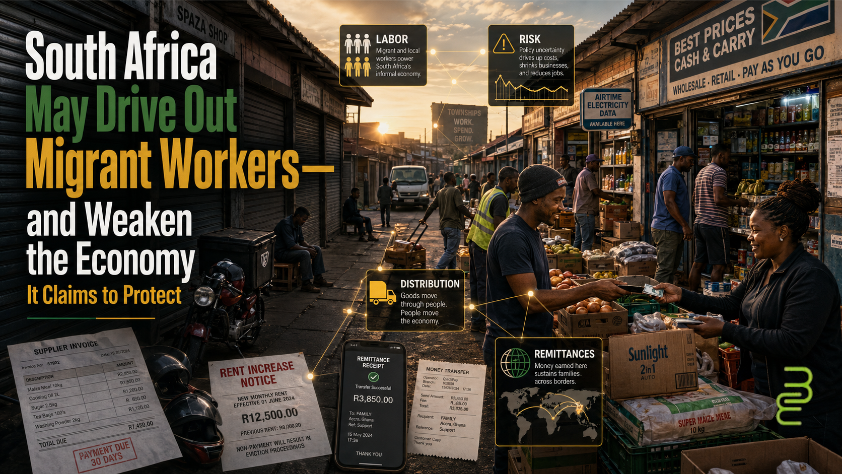
South Africa’s anti-migrant campaign is being sold as economic protection.
The argument is simple: remove undocumented African migrants, and jobs, services and business opportunities will return to South Africans.
But economists are warning that the math may not work that way.
Reuters reports that anti-migrant protests in South Africa are raising concerns about labor shortages across construction, farming, retail, transport, hospitality and delivery services.
The protests have already contributed to fear, departures and disruption in commercial activity.
UN data cited by Reuters estimated that migrants represented about 5% of South Africa’s population in 2024, while an earlier OECD-ILO estimate put migrants’ contribution at about 9% of GDP.
That is the economic tension at the center of this story.
If migrant labor and enterprise are removed from the economy, the result may not be automatic job transfer. It may be lower productive capacity, weaker supply networks, higher operating costs and less consumer demand.
The Protest Argument Treats Migrants as Displacement
Anti-migrant organizers are framing foreign African workers and business owners as competitors for scarce jobs, public services and commercial space.
Reuters previously reported that anti-foreigner groups have accused migrants of taking jobs, using public services and contributing to crime.
That message can gain traction in a country dealing with high unemployment, weak growth and public frustration.
But it also redirects anger away from deeper economic questions.
- Who owns the land, capital, large retailers, logistics systems, finance channels and major employers?
- Who controls procurement, zoning, policing and licensing?
- Who benefits from an economy where both poor South Africans and African migrants compete at the bottom while ownership remains concentrated elsewhere?
The campaign turns a structural problem into a street-level target.
Migrant Labor Is Part of the Productive System
The economic risk is not only about individual workers leaving.
It is about what happens when entire labor and commerce networks are destabilized.
Reuters reported that sectors including construction, farming, retail and transport could be affected by migrant departures.
It also noted the importance of migrant-run informal businesses such as spaza shops, which connect customers, wholesalers, landlords and local supply chains.
That matters because informal commerce is not separate from the economy. It is part of how goods move through communities.
When a migrant-owned shop is forced to close, the impact does not stop with the owner. Suppliers lose orders. Landlords lose rent. Customers may lose nearby access to basic goods. Delivery networks lose density. Local price competition may weaken.
In other words, removing a business does not automatically create another functioning business in its place.
A storefront is not just a location. It is inventory, supplier credit, customer trust, operating knowledge, labor, pricing discipline and risk tolerance.
Who Actually Inherits the Upside?
The core ownership question is this:
Who actually inherits the jobs, stores and market share when migrant workers leave?
Some local competitors may believe they will gain customers, jobs or locations. Political organizers may gain influence by presenting themselves as defenders of citizens.
But employers, consumers, farmers, builders, landlords and delivery platforms may face immediate costs if labor supply and small-business networks shrink.
Reuters’ reporting also highlighted disruption to delivery services, including Shoprite’s Sixty60 platform, where many drivers are non-South African.
That detail matters.
Modern retail depends on labor flexibility, fast delivery, transport routes and last-mile workers.
If those workers are threatened, displaced or forced out, the cost does not stay inside migrant households. It moves into consumer prices, service delays, business continuity and employer risk.
The same logic applies to construction sites, farms, restaurants, informal retail and transport.
The Cost Spreads Across Borders
This is also a regional economic story.
Reuters reported that reduced remittance flows could affect neighboring countries that rely on money sent home by migrants working in South Africa.
That means the cost of anti-migrant disruption can move beyond South Africa’s borders.
A worker leaving Johannesburg, Durban or Cape Town may not only lose income personally. A family in Zimbabwe, Malawi, Mozambique, Ghana or Nigeria may lose financial support. A local business in a neighboring country may lose purchasing power. A household may lose school-fee money, food support or rent assistance.
Reuters has also reported regional diplomatic fallout.
Ghana postponed bilateral meetings with South Africa after anti-migrant violence, while Nigeria reported the deaths of two citizens during the surge in violence and called for accountability.
That is why this story is bigger than immigration enforcement.
It is about labor markets, diplomacy, regional trust and the economic consequences of turning African mobility into a political weapon.
Black African Labor Is Being Made the Scapegoat
For BlackEconomicDevelopment.com, the deeper issue is not only that migrants are being targeted.
It is that Black African labor and enterprise are being framed as the source of scarcity while deeper structural issues remain largely untouched.
South Africa’s economic challenges are real.
Unemployment, inequality, service failures and weak growth place pressure on households and communities. But forcing out African migrants does not automatically create capital access, formal jobs, business financing, land reform, public-service capacity or broad-based ownership.
It may simply remove people who are already participating in the economy as workers, renters, shopkeepers, drivers, consumers and remittance senders.
Reuters reported that President Cyril Ramaphosa condemned immigrant scapegoating and warned against vigilante enforcement as protesters carried out door-to-door intimidation and removals.
That warning points to the policy risk.
When unofficial groups begin deciding who may work, trade or occupy commercial space, the economy becomes less predictable.
Business owners cannot plan. Workers cannot move safely. Consumers cannot rely on local supply. Employers cannot count on labor. The state loses control of enforcement to street politics.
The Economics Behind It
The campaign claims to protect South African workers.
But the economic evidence suggests it could weaken parts of the economy those workers depend on.
Migrant workers are not only job competitors.
They are also producers, renters, consumers, drivers, suppliers, entrepreneurs and taxpayers in direct and indirect ways. Migrant-owned businesses are not only storefronts. They are nodes in local distribution networks.
The real policy question is not whether South Africa should enforce immigration law. Every state has immigration rules.
The question is whether enforcement becomes a substitute for economic development.
If the country does not address job creation, ownership concentration, public-service failure, capital access and township business infrastructure, removing migrants may produce a visible political outcome without solving the economic problem.
It may even make that problem worse.
Why It Matters
This story matters to Black communities across the diaspora because it shows how scarcity politics can divide workers and entrepreneurs who are often navigating the same broken systems.
When unemployment is high and public trust is low, migrants can become the easiest target. But the harder questions are about ownership, capital, state capacity and who controls the productive assets.
South Africa’s anti-migrant campaign may promise protection.
The economic risk is that it removes labor, weakens commerce, damages regional trust and leaves the deeper ownership structure unchanged.

Latest posts by normbond (see all)
- Who Owns the Upside From Power? 50 Cent’s Variety Interview Reveals a Bigger TV Economics Story - October 20, 2026
- Burkina Faso Rejected a U.S. Deportation Deal. Then the Fight Moved to Visa Access. - October 19, 2026
- NC A&T Students Marched 45 Minutes to Vote. The Bigger Story Is Who Controls Access. - October 17, 2026