


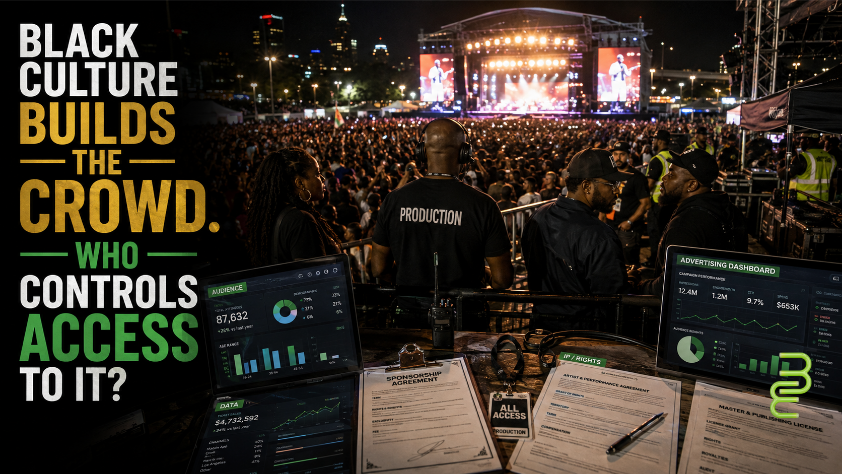
Live Nation Urban founder Shawn Gee recently offered a revealing description of what his company is becoming.
It is no longer enough, he suggested, to think of Live Nation Urban as simply being in the Black live-events business.
“We’re in the Black audience business,” Gee told Forbes.
That distinction deserves attention.
Because Live Nation Entertainment’s own financial statements show that the economics of putting people into a venue can look very different from the economics of selling brands access to those people.
In 2025, Live Nation’s Concerts segment generated approximately $20.9 billion in revenue and $687 million in adjusted operating income, or AOI.
Its much smaller Sponsorship & Advertising segment generated approximately $1.33 billion in revenue — but produced $845 million in AOI.
In other words, Concerts generated nearly 16 times as much revenue, while Sponsorship & Advertising produced more adjusted operating income.
The corresponding AOI margins were 3.3% for Concerts and 63.6% for Sponsorship & Advertising.
Those are Live Nation Entertainment numbers, not financial results for Live Nation Urban. Neither Gee nor other Live Nation Urban executives told Forbes that those parent-company margins are driving their strategy.
But the contrast makes something important visible:
The crowd is one business. Access to the crowd can be another.
The concert may assemble the audience
Concert promotion is an expensive business.
Live Nation says concert revenue is heavily affected by ticket volume and pricing, while artist fees, production expenses and other event costs are substantial. The company specifically notes that large increases in concert-promotion revenue do not necessarily produce comparable increases in operating income.
That helps explain why $20.9 billion of Concerts revenue does not translate into anything close to a similar margin.
But a live event does more than sell tickets.
It also gathers people.
It reveals what they will pay to see, where they will travel, which artists they follow, which cultural properties command their attention and which brands may have an opportunity to reach them.
That is where Live Nation Urban’s changing description of itself becomes economically significant.
Forbes reports that Gee says the company has amassed “tens of millions of pieces of data and audience insights” through festivals, tours and brands. He says companies increasingly approach Live Nation Urban because they want access to those audiences beyond sponsoring a single event.
The economic product is expanding.
From an event business to an audience business
Live Nation Urban’s portfolio spans festivals and cultural properties including Roots Picnic, ONE Musicfest, Broccoli City Festival and Mary J. Blige’s Strength of a Woman Festival & Summit.
The company is also expanding its creator network, developing intellectual property and pursuing international opportunities. Forbes describes a potential flywheel in which live events generate audience relationships and data, those insights become useful to brands, creators extend cultural reach, content maintains engagement, and new intellectual property can generate additional experiences.
Look at the progression:
Culture creates the experience.
The experience creates the audience.
The audience produces relationships and data.
The data helps package access for advertisers and sponsors.
Creators and content extend that access beyond the festival weekend.
New intellectual property gives the system something else to monetize.
At that point, the economics are no longer limited to selling tickets.
The audience itself has become part of the infrastructure.
Why brands want the Black audience
The market case is not difficult to find.
Nielsen says Black buying power is projected at $2.1 trillion in 2026. Its 2026 research found that 67% of Black consumers surveyed pay more attention to brands that reflect their culture, while 52% said they are more likely to purchase from established brands that partner with creators, personalities or organizations tied to their interests.
That creates commercial demand for something more valuable than generic reach.
Brands want relevant reach.
They want an audience whose interests can be understood, segmented and reached through culturally credible environments.
That makes the entity controlling the relationship between the audience and the advertiser strategically important.
Live Nation’s broader Sponsorship & Advertising business demonstrates how economically attractive that layer can be.
The company reported that sponsorship revenue rose 11% in 2025, driven in part by naming-rights deals, venue sponsorships, digital integrations and expanded partnerships. It also reported about $1.7 billion in contracted sponsorship revenue tied to future benefits as of the end of 2025.
That does not tell us what a Black audience is worth to Live Nation Urban specifically.
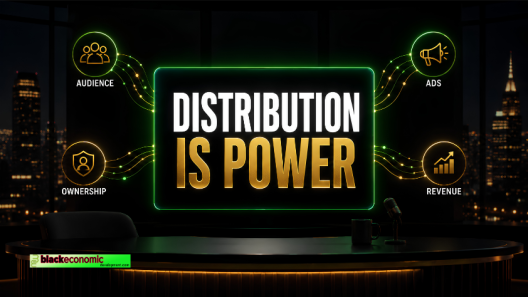
It does tell us that owning the channel between audiences and advertisers can be a serious business.
Black buying power is only part of the story
For years, Black consumer economics have often been discussed through a familiar statistic: buying power.
How much can Black consumers spend?
That matters.
But it is not the same as asking where the economic value surrounding that spending accumulates.
If Black audiences attend the festival, follow the creator, generate the engagement and attract the brand dollars, there is another set of questions we at BEDC must ask.
Who owns the customer relationship?
Who controls the audience data?
Who determines which advertisers gain access?
Who owns the intellectual property developed around the audience?
Who receives equity when a cultural property scales?
And how much of the value created around Black audiences accumulates in Black-owned businesses, creator-owned assets and locally controlled enterprises?
Those questions become particularly important as Live Nation Urban looks abroad.
Gee told Forbes that international expansion may involve not simply exporting American festivals, but identifying entrepreneurs and cultural brands already operating in other markets and helping them scale through investment, resources and infrastructure. Forbes also reports that some Live Nation Urban partnerships have involved equity and ownership opportunities.
That could expand access to capital and distribution for Black entrepreneurs.
But the economic outcome will depend on the details.
Scaling Black culture is not automatically the same thing as scaling Black ownership.
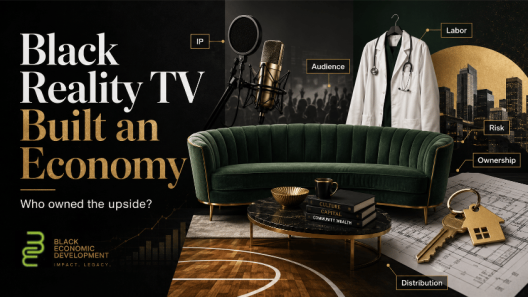
Who owns the upside?
There is nothing new about corporations recognizing that Black culture attracts attention.
What is changing is the sophistication with which that attention can be converted into assets.
Events can generate data.
Data can improve advertising.
Creators can extend distribution.
Content can maintain engagement.
Intellectual property can create recurring products.
And the company that sits across those layers can potentially earn money from the audience repeatedly rather than once.
That is why Gee’s phrase — “Black audience business” — deserves more than a passing mention.
The underlying asset is not simply a festival.
It is the relationship with the people who make that festival valuable.
Live Nation Entertainment’s numbers provide a striking reminder of why that distinction matters: in 2025, a Sponsorship & Advertising business generating roughly $1.3 billion in revenue produced more adjusted operating income than a Concerts business generating nearly $21 billion.
Again, those are not Live Nation Urban’s economics.
They are something more useful for understanding the strategy:
a demonstration of how differently the economics can work once the product is no longer just the show, but access to the audience around it.
Black culture can build the crowd.
The ownership question begins with who controls what happens after the crowd arrives.
Attention
Events
→
Audience relationship
→
Data
→
Brand access
→
Sponsorship / advertising
→
IP
→
Recurring economic value
Editor’s financial note
Live Nation reports adjusted operating income, or AOI, as a non-GAAP measure used to evaluate its operating segments. The company says AOI should be considered alongside, not as a substitute for, GAAP operating income and other financial measures.
Latest posts by normbond (see all)
- Black Culture Builds the Crowd. The Bigger Money May Be in Who Controls Access to It - September 2, 2026
- Harrison Barnes Is Turning $25 Million of NBA Earnings Into Bank Ownership - August 31, 2026
- Roblox Built a Creator Economy. Steal an Egg Shows Who Sets the Rules - August 28, 2026