



MACRO has spent more than a decade building a media business around developing, financing and producing stories.
Now it owns something different: a direct route to the audience.
Charles D. King’s MACRO has acquired ALLBLK, the Black-focused streaming service, from AMC Global Media.
The transaction marks MACRO’s first move into direct-to-consumer streaming and pushes the company farther down the media value chain.
Financial terms were not disclosed.
That missing number matters. But the larger economic shift is already visible.
Until now, much of MACRO’s power came from helping determine what gets made.
ALLBLK gives it greater control over where content can go—and a more direct relationship with the people watching it.
That changes the economics.
From Making Content to Controlling Distribution
A production company can develop a project, finance it, produce it and then sell or license it to another platform.
But once that project reaches an outside streamer, broadcaster or distributor, another company typically controls the customer environment.
The platform determines what gets promoted. It maintains the subscriber relationship. It sees how viewers interact with the service. And it controls an important part of the route between the content and its audience.
Owning a streaming service moves MACRO into that part of the business.
ALLBLK gives the company a direct-to-consumer platform explicitly built around Black programming and Black audiences.
MACRO says it plans to invest in new original programming, audience development, community engagement and broader creative collaboration across its studios and network.
The company’s value chain can now potentially reach farther:
Development => Financing => Production => Programming => Distribution => Audience Relationship
The final step may be the most important addition.
The Audience Relationship Is an Asset
Media companies do not compete only for hit shows.
They compete for relationships.
A company with a direct consumer platform can maintain a connection with viewers beyond the release of a single movie or television series.
That relationship can inform programming, marketing, advertising, retention efforts and future intellectual-property development.
It can also give a media company more leverage.
Instead of relying entirely on another distributor to decide whether content reaches viewers, MACRO now controls a platform of its own.
For a company whose business has centered on stories and creators from underrepresented communities, that is a significant strategic shift.
MACRO is no longer positioned only as a supplier trying to get projects through somebody else’s gate.
It now controls a gate of its own.
AMC Is Still Part of the Economics
The acquisition does not mean AMC disappears from the picture.
AMC Global Media will remain involved as an investor in MACRO, and the companies have established a new content-licensing agreement.
That distinction matters.
Selling control of an asset does not necessarily mean giving up every opportunity to make money from it.
AMC can retain an economic relationship through its investment and licensing arrangement while MACRO takes control of the platform and its next phase.
ALLBLK is expected to continue operating with its existing platform and content library.
The ownership may have changed.
The economic relationship between the companies continues.
What Could This Mean for Black Creators?
The acquisition also creates a larger question for the Black creative economy.
A Black-led media company controlling a streaming platform potentially creates another buyer and distribution route for programming aimed at Black audiences.
But ownership by itself does not guarantee wider access.
What matters next is how MACRO uses the platform.
- Will ALLBLK expand opportunities for independent producers?
- Will MACRO commission more original programming from outside its own studio network?
- Will the company use its closer audience relationship to invest in new creators, genres and intellectual property?
- Or will tighter vertical integration concentrate more programming decisions inside one corporate ecosystem?
Those questions will determine whether this transaction expands opportunity throughout the Black media economy or primarily creates more leverage for MACRO itself.
Distribution Comes With Risk
Moving farther down the value chain does not mean MACRO simply captures more upside.
It also takes on more risk.
Streaming platforms have to attract viewers, retain subscribers, invest continuously in programming and operate the technology and infrastructure behind the service.
Customer acquisition costs money.
Churn can weaken recurring revenue.
Programming requires capital.
And the streaming business has already shown that simply having good content does not guarantee a sustainable platform.
That means MACRO is accepting a different set of responsibilities than it carries when financing or producing an individual film or television project.
Vertical integration creates more places to capture value.
It also creates more places to carry the cost.
Black Media Ownership Is Also About the Last Mile
Black media conversations frequently focus on representation.
- Who gets cast?
- Who directs?
- Who produces?
- Who gets a development deal?
Those questions matter.
But economic power also exists farther downstream.
Who controls distribution?
Who owns the customer relationship?
Who decides what reaches the audience?
Who learns from that audience?
And who is positioned to turn those relationships into future intellectual property, advertising revenue and business leverage?
For decades, Black creators and media companies have often produced valuable culture inside distribution systems controlled elsewhere.
The ALLBLK acquisition moves the ownership question closer to the audience.
MACRO already had the capacity to help decide what gets made.
Now it also has greater control over where some of that content can live and how directly the company can reach viewers.
That makes this more than another streaming acquisition.
It is a move downstream in the economics of Black media.
The Economics Behind It
The strategic asset in this deal is not simply ALLBLK’s content library.
It is distribution plus relationship.
If MACRO can successfully combine its development and production capabilities with ALLBLK’s direct audience connection, the company could capture value across more of the media chain instead of stopping when a project is delivered to somebody else’s platform.
That opportunity comes with the costs and risks of operating a streaming business.
And financial terms of the acquisition remain undisclosed, making it impossible to know from the public announcement what MACRO paid or precisely how the transaction was valued.
But the change in control is clear.
MACRO made Black stories before this deal.
Now it controls a direct path between some of those stories and the people watching them.
The acquisition is complete.
The more important story starts now:
What does MACRO do with the gate it controls?
The value of ALLBLK is not limited to its programming. The acquisition gives MACRO a distribution layer and a direct consumer relationship that can potentially connect development, financing, production, programming and audience learning within the same media company.
The crucial question is: What will MACRO do with the gate it now controls—and will that control create broader opportunity for Black creators, or primarily more leverage for MACRO itself?
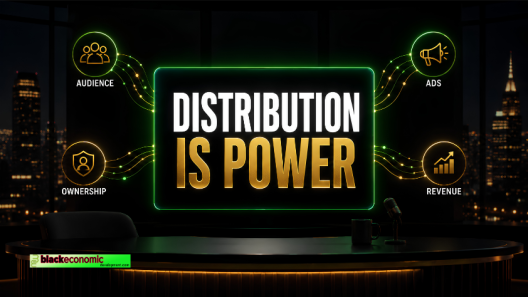
Representation determines who appears in the media economy. Distribution helps determine who has leverage inside it.
The ALLBLK deal moves MACRO closer to the viewer, where subscriber relationships, programming decisions, audience knowledge and future intellectual property can become economic assets.

Latest posts by normbond (see all)
- MACRO Bought ALLBLK. The Bigger Prize Is the Direct Relationship With Black Viewers. - September 18, 2026
- Kaepernick Says Jay-Z Gave the NFL Something It Couldn’t Own: Black Cultural Legitimacy - September 18, 2026
- Nairobi Won the 2029 World Athletics Championships. Now Comes the Ownership Test. - September 15, 2026