

Part 2 of the Black Creators, AI, and Ownership series
In part one of this series, we looked at the harm.
AI-generated Black women are going viral while real Black women’s faces, dances, styling, movement, audience behavior, and cultural identity are being treated as unpaid inputs for synthetic media.
The economic issue is not only that the images are fake.
The issue is that Black women’s digital labor can be copied, remixed, sexualized, scaled, and monetized without consent. A Glamour investigation documented how some AI-generated Black female personas appear to draw from real creators’ content and are sometimes connected to subscriber or adult-content ecosystems.
That is the extraction side of the story.
Now comes the response.
If AI is learning from Black creators, Black creators need to learn the tools.
Not because AI is harmless.
Not because education solves every legal, cultural, or platform problem.
But because ignorance is expensive in a market that is already moving.
Education is protection
AI education is often marketed as a productivity hack.
Learn prompts.
Make content faster.
Automate your workflow.
Save time.
But for Black creators, entrepreneurs, coaches, consultants, filmmakers, agencies, and independent operators, AI education has to mean something deeper.
It is not just about making more content.
It is about understanding how content can be copied.
- How likeness can be replicated.
- How motion can be imitated.
- How style can be converted into output.
- How synthetic media accounts are built.
- How platforms reward engagement.
- How audience behavior becomes data.
- How intellectual property can be weakened when creators do not document, license, or protect their original work.
That is why learning AI is not only a skills issue.
It is an ownership issue.
You cannot protect what you do not understand
Black creators do not need to become machine learning engineers to protect themselves.
But they do need enough literacy to understand what is happening around them.
They need to know the difference between using AI as a tool and becoming raw material for someone else’s AI product.
They need to understand how image generation, face swapping, voice cloning, video synthesis, prompt workflows, and content scraping can affect their work.
They need to know what rights they are giving away when they upload content, sign brand agreements, join platforms, use AI tools, or license their image.
They need to know how to keep records of original work.
They need to know how to prove authorship.
They need to know when to use contracts.
They need to know when to say no.
Because the AI economy rewards speed.
But ownership requires judgment.
The goal is not just adoption. It is leverage.
A lot of AI content tells people to “adopt AI before it is too late.”
That framing is incomplete.
The real question is: adopt AI on whose terms?
If Black creators only use AI to produce more posts for platforms they do not own, they may increase output without increasing power.
If they use AI without understanding rights, licensing, data, and distribution, they may accelerate their own dependency.
If they use AI to imitate trends instead of building ownable assets, they may create more noise without creating long-term value.
The goal should not be blind adoption.
The goal should be leverage.
That means using AI to build things that can be owned, licensed, sold, protected, taught, or distributed beyond one platform.
From unpaid input to paid producer
The most important shift is this:
Black creators must move from being unpaid inputs to paid producers.
An unpaid input is a face, dance, phrase, voice, visual style, or cultural signal that feeds someone else’s product.
- A paid producer owns or controls the asset.
- A paid producer understands the workflow.
- A paid producer documents the work.
- A paid producer negotiates the usage.
- A paid producer builds audience access outside the platform.
- A paid producer can turn creative labor into IP, services, education, licensing, consulting, film, products, media, or community.
That is the economic move.
AI will continue to create risk.
But it can also create production capacity for creators who learn how to use it with ownership in mind.
AI filmmaking is one example
This is why AI filmmaking education matters.
A workshop, lab, or training session on AI filmmaking is not just about making cool visuals.
- It can teach creators how synthetic media is built.
- How storyboards become scenes.
- How prompts shape characters.
- How images become motion.
- How editing workflows change.
- How creative direction still matters.
- How original stories can become ownable media assets.
For Black creators, this matters because traditional film, television, and media production have often required access to capital, crews, studios, distribution relationships, and gatekeepers.
AI does not remove the need for taste, judgment, writing, editing, sound, rights, ethics, or business structure.
But it can lower the cost of experimentation.
It can help a creator make a proof of concept.
It can help a small business produce branded media.
It can help an educator build visual lessons.
It can help a storyteller develop a short film, pitch deck, trailer, concept reel, or digital series.
The economic opportunity is not the tool itself.
The opportunity is what the tool helps a creator own.
The next Black media opportunity is workflow ownership
Black culture has always powered media.
Music, dance, fashion, humor, language, sports, beauty, commentary, and storytelling all move markets.
But the recurring economic question remains the same:
Who owns the platform?
Who owns the audience?
Who owns the IP?
Who owns the data?
Who owns the distribution?
AI adds another layer:
Who owns the workflow?
The person who understands the workflow can create faster, negotiate smarter, identify misuse earlier, and build assets more deliberately.
The person who does not understand the workflow may not realize their work has already become someone else’s input.
That is why workflow literacy matters.
Education also helps identify the builders
The response to AI extraction will not come from individual creators alone.
It will require an ecosystem.
That ecosystem includes:
AI educators.
Black-owned media labs.
Digital rights advocates.
IP attorneys.
Creator collectives.
Cybersecurity experts.
Image-abuse prevention groups.
Platform accountability researchers.
Filmmakers experimenting with responsible AI.
Business coaches helping creators structure their work.
Organizations teaching entrepreneurs how to use AI without giving away trust, voice, or control.
This is where BlackEconomicDevelopment.com plays a role.
We not only report on the harm.
Our intent is to help our readers find the people and organizations building leverage against the harm.
We create a stronger editorial lane: not just critique, but connection.
Stronger laws still matter
Education is not a replacement for policy.
Creators should not have to personally fight every platform, account operator, scraper, or synthetic media tool on their own.
Stronger likeness rights matter.
Clearer AI disclosure rules matter.
Better takedown systems matter.
Stronger platform enforcement matters.
Adult-content and subscription platforms should face serious scrutiny when synthetic personas appear to be based on real people.
Brands should be careful about using AI-generated imagery that imitates real creators or racialized aesthetics without accountability.
But while the law catches up, creators need practical knowledge now.
Waiting for perfect regulation is not a strategy.
Better platform enforcement still matters
Platforms cannot claim neutrality while profiting from engagement.
If synthetic content generates views, comments, shares, and data, platforms benefit even when the content is later removed.
That means enforcement cannot only happen after harm spreads.
Platforms need better labeling.
Faster reporting.
Clearer appeals.
More transparent AI policies.
Stronger protections for private individuals.
Better systems for detecting impersonation, likeness abuse, and non-consensual synthetic content.
But again, creators need enough literacy to know what to report, how to document it, and what evidence to preserve.
Education makes enforcement more usable.
Creator education is economic defense
For Black creators, education can support several forms of defense.
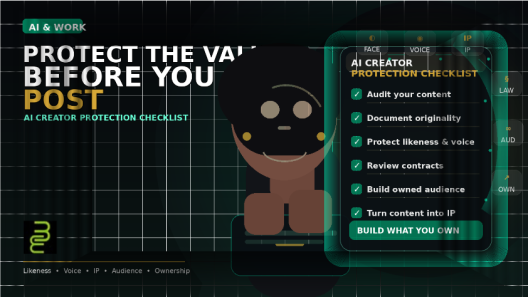
- It can help protect likeness.
- It can help document originality.
- It can help define usage rights.
- It can help identify when content has been copied.
- It can help creators negotiate brand deals with clearer AI clauses.
- It can help creators decide what not to post publicly.
- It can help them separate personal identity from brand assets.
- It can help them build owned audiences through email lists, websites, memberships, or communities.
- It can help them turn content into IP instead of letting every post disappear into the platform feed.
That is the difference between being visible and being positioned.
What Black creators should learn first
Black creators do not have to learn everything at once.
But they should understand the basics.
They should know how AI image and video tools work at a practical level.
They should understand what training data, scraping, prompting, and synthetic media mean.
They should know how to organize source files, drafts, timestamps, contracts, and published links.
They should know how to read platform policies around AI-generated content, likeness, and impersonation.
They should know how to add AI and likeness language to contracts.
They should know the difference between creating content for reach and building assets for ownership.
They should know how to use AI to support their own strategy, not replace their judgment.
Because the future belongs to creators who can combine culture, tools, judgment, and ownership.
This is not about fear. It is about position.
The response to AI exploitation cannot be only fear.
Fear can alert people to harm, but it does not create strategy.
The better response is position.
Black creators need to be positioned as rights holders.
As producers.
As educators.
As owners.
As technologists.
As media builders.
As licensing partners.
As founders.
As institutions.
As people who understand the tools well enough to use them, challenge them, and profit from them on better terms.
That is the shift from extraction to ownership.
The bottom line
AI is not waiting.
It is already moving through social platforms, creator tools, media workflows, advertising, entertainment, education, and small business operations.
The question is not whether Black creators should pay attention.
The question is whether they will be positioned inside the AI economy as owners or as inputs.
Education is not the full solution.
But it is part of the defense.
It helps creators understand the systems that are learning from them.
It helps them document and protect their work.
It helps them negotiate from a stronger position.
It helps them build media assets instead of only feeding platforms.
And it helps them see the difference between content that gets attention and IP that can create lasting value.
Because in the AI economy, the warning is simple:
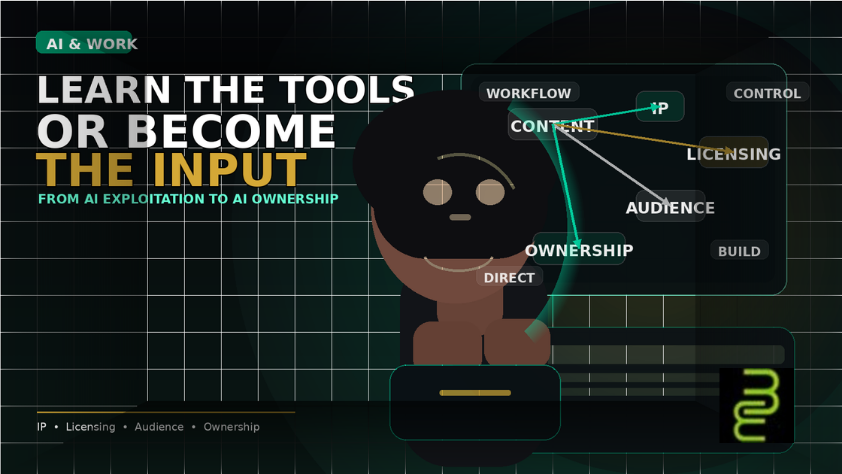
Learn the tools, or become the input.
Economic implication
AI education is becoming a form of economic defense.
For Black creators and independent operators, the value is not only in using AI to create faster. The value is in understanding how AI workflows can affect ownership, likeness rights, contracts, licensing, production, distribution, and audience control.
The upside goes to creators who can turn AI literacy into ownable assets, paid services, stronger negotiations, and protected IP.
The risk falls on creators who remain visible but unprotected, influential but unpaid, and culturally valuable but economically exposed.
Why it matters
Black culture creates enormous value in the digital economy.
But value without ownership becomes extraction.
AI literacy can help Black creators move from being copied by systems they do not understand to building, licensing, teaching, producing, and owning with greater control.
This is not just a technology issue.
It is a Black economic development issue.
Ownership question
Will Black creators remain raw material for AI systems, or become owners, builders, licensors, educators, and producers inside the AI economy?
Your View
What is the smarter response to AI extraction: stronger laws, better platform enforcement, creator education, or all three? Drop it in the comments.
Coming Wednesday: Part three of our Black Creators, AI, and Ownership series turns strategy into action with a practical checklist for protecting your likeness, content, voice, audience, and IP before posting more content in the AI era.
Latest posts by normbond (see all)
- Black Family Wealth Fell 25%. The Ownership Gap Is the Bigger Story. - October 16, 2026
- Rihanna Turned a TikTok Live Into a Storefront. That Changes the Economics of Celebrity Attention. - October 14, 2026
- The Atlanta Dream Built the Demand. The Arena Calendar Still Controls the Opportunity. - October 13, 2026