


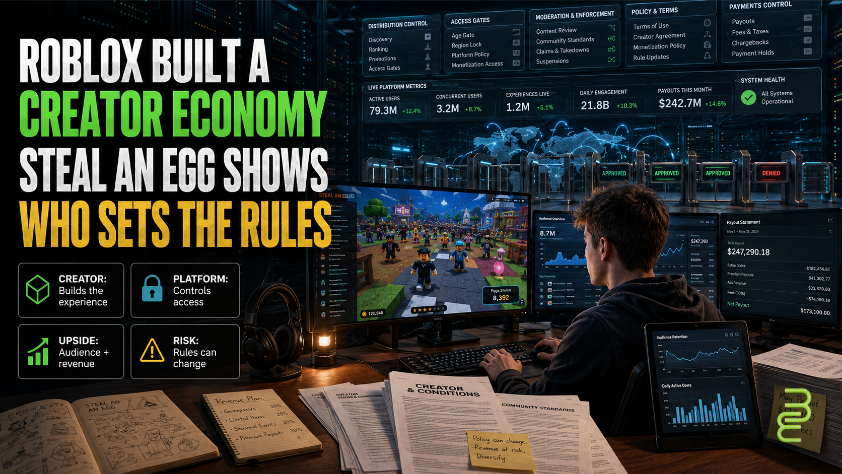
Five years after Roblox was celebrated for letting young developers turn games into businesses, its hottest viral controversy reveals the other side of platform economics: creators build the hits, but Roblox governs the marketplace.
In 2021, Roblox looked like an economic breakthrough.
Anyone could learn relatively accessible development tools, build a multiplayer game, put it in front of millions of players and potentially turn that creation into a real business.
Polygon described Roblox at the time not simply as a game, but as a platform and storefront where people play games made by other developers.
That distinction was central to Roblox’s rise.
Roblox did not need to create every successful game itself. It created the tools, infrastructure, audience and economic system that allowed other people to make them.
Five years later, Steal an Egg shows the other side of that bargain.
Its developers could build one of the hottest games on Roblox.
But Roblox still owned the gate.
Roblox lowered the barrier to becoming a developer
The early economic promise of Roblox was unusually compelling.
As Polygon explained in 2021, Roblox supplied much of what an aspiring developer would otherwise have to build or buy: development tools, multiplayer infrastructure, server support, distribution and access to an existing audience.
Creators supplied the games.
Players could enter those games for free and spend Robux, Roblox’s virtual currency, on virtual items, upgrades and other in-game purchases.
Developers could earn Robux from qualifying activity and, if eligible, convert earnings into real money through Roblox’s Developer Exchange program.
That created genuine economic access.
A young developer did not necessarily need a major publisher, a global server network or millions of dollars in startup capital just to find out whether people wanted to play an idea.
Build it. Find an audience. Monetize if it works.
When Roblox went public in March 2021, Polygon reported that the company finished its first trading day with a market capitalization of roughly $45 billion.
The market was not merely valuing a collection of children’s games.
It was valuing the infrastructure underneath an emerging creator economy.
Then came Steal an Egg
The economic loop inside Steal an Egg is easy to understand.
Players collect and steal eggs, hatch pets and improve their ability to move faster. Speed matters, and Polygon reported that players could improve it manually by running on an in-game treadmill or accelerate progression through spending.
That creates a familiar gaming tradeoff:
Spend money or spend time.
Then the treadmill added something unusual.
A feature called Reels displayed a stream of short-form videos while players trained. Screenshots of the mechanic spread quickly across social media, and Polygon reported that a YouTube video showing it in action drew 1.3 million views.
The reason people found it unsettling was not hard to understand.
A player’s repetitive downtime had itself become another opportunity to capture attention.
Money wasn’t the only currency
This is where the economics become more revealing.
Steal an Egg effectively placed two forms of payment next to each other.
A player could spend money to reduce the grind.
Or the player could spend time inside the grind while consuming more content.
The valuable resource, then, was not only Robux.
It was attention.
That places the controversy inside a much larger digital economy.
TikTok wants another swipe.
YouTube wants another video.
Streaming services want another episode.
Mobile games want another session.
Across the internet, companies compete not only for dollars but for minutes, clicks, views and habitual engagement.
The strange power of the treadmill mechanic was that it appeared to turn even waiting into economically useful attention.
The screen no longer needed dead time.
Then the platform stepped in
After reaching No. 1 on Roblox and drawing widespread attention, Steal an Egg was taken offline or delisted, according to Polygon.
The exact reason for that initial removal has not been publicly established in the material reviewed for this story. It would therefore be inaccurate to say Roblox “banned” the game for a confirmed reason.
What happened next is clearer.
On Aug. 25, Roblox announced a new restriction affecting games in Roblox Kids and Select. Effective immediately, games would not be allowed in those environments if they combined a media feed, autoplay or continuous scrolling, and a reward or implied reward for continued watching.
Roblox said rewarding younger users for consuming continuous feeds without natural stopping points was inappropriate. Noncompliant games can lose access to Kids and Select until their mechanics are redesigned and reviewed again.
That is more than a content-moderation footnote.
It is an example of economic power.
The creator built the game. Roblox sets the market rules.
This is the distinction the 2021 Roblox story foreshadowed.
Roblox gave creators extraordinary access.
But access did not mean control.
A developer can determine what happens inside a game.
Roblox determines the conditions under which that game can participate in the marketplace Roblox owns.
Those are different forms of power.
The developer creates the experience, mechanics, community appeal and game-level intellectual property.
Roblox controls critical infrastructure surrounding that experience: distribution, technical systems, platform eligibility and the rules governing participation.
That is what platform ownership looks like.
A platform does not need to own every successful product.
It can hold the more powerful position by owning the market where those products depend on being distributed.
The controversy did not erase demand
There is another important signal in what happened next.
The underlying game continued attracting an enormous audience after the controversy.
Independent snapshots drawing on Roblox’s public Games API showed Steal an Egg at roughly 800,000 concurrent players after its return, including a reported count above 804,000 on Aug. 26.
That figure should be treated as a dated snapshot rather than an all-time peak. Concurrent player counts change constantly, and available trackers report different historical highs.
But the larger point is clear:
Removing the controversial mechanic did not eliminate demand for the game.
The feature was disposable.
The audience was not.
That makes the ownership structure even more visible.
The developer still had a hit.
Roblox still controlled the marketplace where that hit could operate.
Who captures the upside?
There are several layers of economic upside in a successful Roblox game.
Developers can earn revenue and build valuable intellectual property around the experiences they create.
YouTubers, streamers and publishers can capture secondary attention around those experiences. The Steal an Egg controversy itself became content capable of generating millions of views outside Roblox.
Players receive entertainment, virtual goods and status within the game.
But Roblox occupies the broadest structural position.
One game can rise.
Another can replace it.
Thousands of creators can compete for attention.
The platform remains underneath all of them.
That is why Roblox’s economic asset has always been bigger than any individual game.
It built an economy where other people continually create the inventory.
Who carries the risk?
Creators carry entrepreneurial risk.
They invest labor, creativity and often money without knowing whether an audience will appear.
Success does not eliminate that risk. A developer operating inside someone else’s marketplace remains exposed to platform policies, eligibility requirements and distribution decisions.
Players carry spending and attention risk.
Game mechanics can create friction that makes paid shortcuts more appealing. Steal an Egg added another possibility: even the unpaid route could keep generating value by holding the player’s attention.
Roblox carries governance and reputational risk.
If creator experimentation produces mechanics the company considers inappropriate for younger users, Roblox ultimately has to police the boundary.
Control captures upside.
Control also carries responsibility.
Why this matters to Black creators
There is no evidence in the material reviewed for this story that Black Roblox users were uniquely affected by the Steal an Egg controversy.
The Black economic relevance is structural.
Black creators, developers, musicians and entrepreneurs increasingly build businesses through platforms they do not own.
- YouTube can provide an audience.
- TikTok can provide discovery.
- Spotify can provide distribution.
- Amazon can provide a marketplace.
- Roblox can provide an entire development and gaming economy.
Those systems can dramatically lower the cost of entering a market. That economic access is real and valuable.
But three assets should not be confused:
The thing you create.
The audience you attract.
The infrastructure that gives you access to that audience.
A creator may own the first.
A creator may influence the second.
But another company often owns the third.
And ownership of the third can determine the economics of everything above it.
For Black creators and founders, that raises a more durable question than whether a platform can generate income:
What do you own after the income arrives?
Is it intellectual property?
A direct customer relationship?
An email list?
A trademark?
Licensing rights?
Data?
Cash reserves?
Distribution you can control?
A business that can survive if one platform changes the rules?
Revenue matters.
But durable economic power requires assets.
The economics behind it
Roblox’s breakthrough was lowering the cost of becoming a game developer.
Its competitive advantage was retaining control of the market those developers depend on.
That does not make Roblox’s creator economy an illusion.
It makes it a platform economy.
- Creators can earn.
- Creators can scale.
- Creators can build valuable intellectual property.
But when someone else controls access, distribution and the rules of the marketplace, success does not automatically become independence.
Steal an Egg made that relationship unusually visible.
Five years after Roblox showed creators how much they could build, one viral game reminded everyone who still owns the gate.
Who owns the upside?

Latest posts by normbond (see all)
- Roblox Built a Creator Economy. Steal an Egg Shows Who Sets the Rules - August 28, 2026
- Bill Gates Says AI Could Replace Workers Across the Economy. The Bigger Question Is Who Gets the Money. - August 27, 2026
- MTN Wants to Control Credit. Gulf Capital Is Helping Build Its AI Infrastructure. - August 26, 2026