


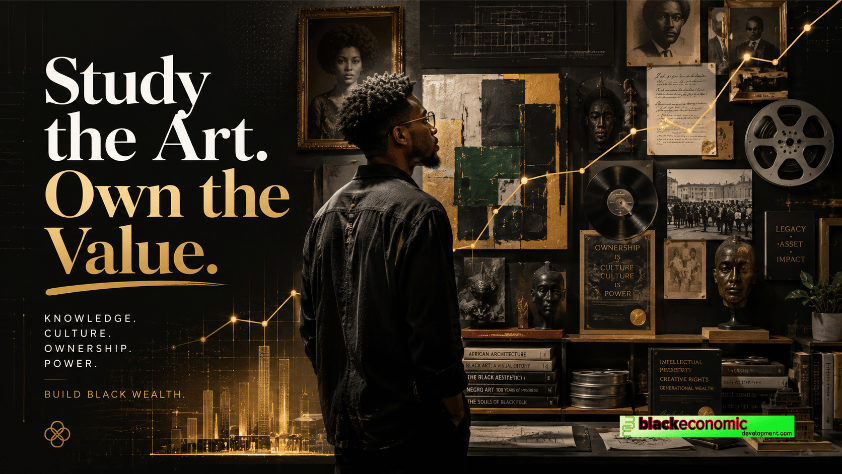
Yasiin Bey’s (formerly Mos Def) message to Black artists was direct: study Black art.
Study the history.
Study the painters, the writers, the architects, and the full creative lineage.
On the surface, that sounds like artistic advice.
But underneath it is an economic lesson.
Black culture creates enormous value across music, fashion, film, advertising, streaming, sports, design, social media and technology.
The question is whether Black creators understand the systems that turn that value into ownership, licensing, publishing, equity, archives, catalogs, brands, and institutions.
Art history is not just about knowing names.
It is about knowing how value travels.
- A song becomes a sample.
- A phrase becomes a brand.
- A visual style becomes a campaign.
- A neighborhood aesthetic becomes a fashion trend.
- A movement becomes content.
- A person becomes intellectual property.
The creator may get attention first. But attention is only the opening asset.
The bigger question is who owns the underlying work, the audience relationship, the distribution channel, the publishing rights, the footage, the catalog, the trademark, the data, and the platform where the culture circulates.
That is why Yasiin Bey’s advice matters.
Studying Black art history gives artists a map. It shows how Black genius has been borrowed, copied, monetized, underpaid, archived, resold, and sometimes institutionally controlled by people who did not create it.
It also shows another path.
Black artists can build companies, own masters, protect publishing, license images, control archives, invest in studios, create schools, build collectives, fund galleries, and turn creative influence into durable wealth.
The lesson is not only “respect the past.”
The lesson is: know the lineage so you can own the future.
The economic implication
Black cultural production is often treated as talent, vibe, influence, or content.
But economically, it is also intellectual property, brand equity, audience power, licensing value, and institutional capital.
When artists do not study the history, they risk repeating the same pattern: creating the value while someone else owns the structure that monetizes it.
That structure may be a label, a gallery, a platform, a studio, a publisher, a streaming service, an algorithm, a brand partner, or an archive.
The names change.
The ownership question does not.
Why this matters
For Black creators, this is about leverage.
For Black communities, it is about whether cultural value becomes jobs, ownership, archives, businesses, schools, funds, studios, and institutions.
For Black media, it is a reminder that every viral cultural moment should lead to the same question:
Who captures the upside?
Yasiin Bey’s advice is not just about becoming a better artist.
It is about becoming harder to extract from.
Ownership question
When Black artists study Black art history, what should they be studying most closely: the creative work, the business models, the ownership structures, or the institutions that preserved and profited from it?
Latest posts by normbond (see all)
- Porsha Williams’ Fibroid Emergency Points to a Bigger Economic Cost for Black Women - September 19, 2026
- MACRO Bought ALLBLK. The Bigger Prize Is the Direct Relationship With Black Viewers. - September 18, 2026
- Kaepernick Says Jay-Z Gave the NFL Something It Couldn’t Own: Black Cultural Legitimacy - September 18, 2026