



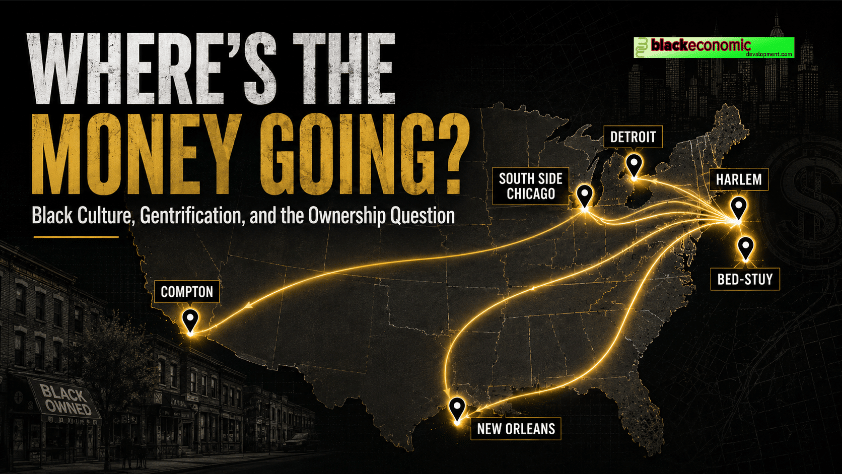
In my now 13-year-old video shot in Harlem, I asked a question that still lands today:
Where’s the money going?
Back then I stood near 125th Street, surrounded by the symbols of Black history and the signs of commercial change. Harlem was still Harlem in name, memory, and cultural identity.
But the storefronts, vacant lots, chain retailers, and development patterns raised a deeper concern.
Money was clearly moving through the neighborhood.
The question was whether Black residents, Black businesses, and Black institutions were capturing enough of it.
That question now reaches far beyond Harlem.
It applies in Bed-Stuy, where Black cultural identity remains powerful even as affordability pressures reshape who can stay.
It applies in South Side Chicago, where Black neighborhoods carry deep political, cultural, and entrepreneurial history while still fighting disinvestment, uneven development, and outside speculation.
It applies in Detroit, where revitalization raises hard questions about who benefits from recovery.
It applies in New Orleans, where Black culture drives tourism, music, food, festivals, and global attention, while many Black residents face rising housing costs and limited ownership of the industries built around that culture.
It applies in Compton, where a city known worldwide through Black music, sports, and street culture faces the same question as other urban centers:
How does cultural recognition become community wealth?
Gentrification Is About More Than Rent
Gentrification is usually discussed as a housing issue.
That makes sense. Rent increases, property taxes, evictions, and displacement are the most visible pain points.
But the economics run deeper.
Gentrification is also about who owns the land.
- Who controls the commercial corridors.
- Who gets financed.
- Who gets featured.
- Who gets public investment.
- Who gets to open a business.
- Who gets priced out of the storefront.
- Who gets to convert neighborhood identity into profit.
A neighborhood can keep its Black cultural image while losing Black economic control.
That is the part that often gets missed.
Black Culture Creates Value Before Black Communities Capture It
Harlem, Bed-Stuy, Detroit, New Orleans, South Side Chicago, Compton, Oakland, Atlanta, and other Black cultural centers have created enormous value.
That value shows up in music, food, fashion, language, political history, art, nightlife, tourism, sports, film, social media, and real estate branding.
Developers understand this.
Tourism boards understand this.
Lifestyle magazines understand this.
Restaurants, hotels, influencers, streaming platforms, and real estate agents understand this.
The danger is that Black communities can become the source of a neighborhood’s value without owning the assets that appreciate from that value.
When that happens, culture becomes a marketing tool, not a wealth-building engine.
The neighborhood is celebrated.
The history is packaged.
The “vibe” is monetized.
But the upside moves somewhere else.
The Question Is Not Just “Buy Black”
Supporting Black-owned businesses matters.
But “buy Black” by itself is not enough if Black businesses are fighting expensive leases, limited capital, weak digital visibility, poor procurement access, and customer habits shaped by convenience platforms.
The issue is not only whether Black people spend money.
Black consumers spend money every day.
The issue is whether enough of that spending circulates through Black-owned businesses, Black-owned property, Black-led institutions, and community-controlled platforms long enough to build wealth.
That is the real meaning behind the question:
Where’s the money going?
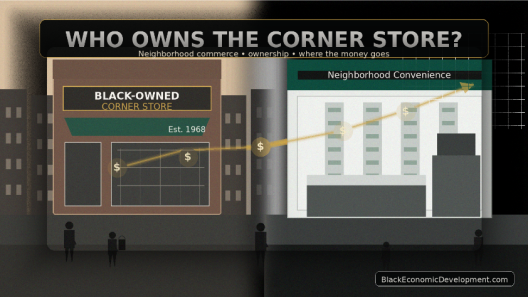
If dollars enter a Black neighborhood but quickly leave through outside landlords, national chains, external vendors, distant banks, and digital platforms, the community may create activity without building ownership.
That is economic leakage.
And leakage is one reason cultural power does not always become economic power.
The Rise of Organized Spending
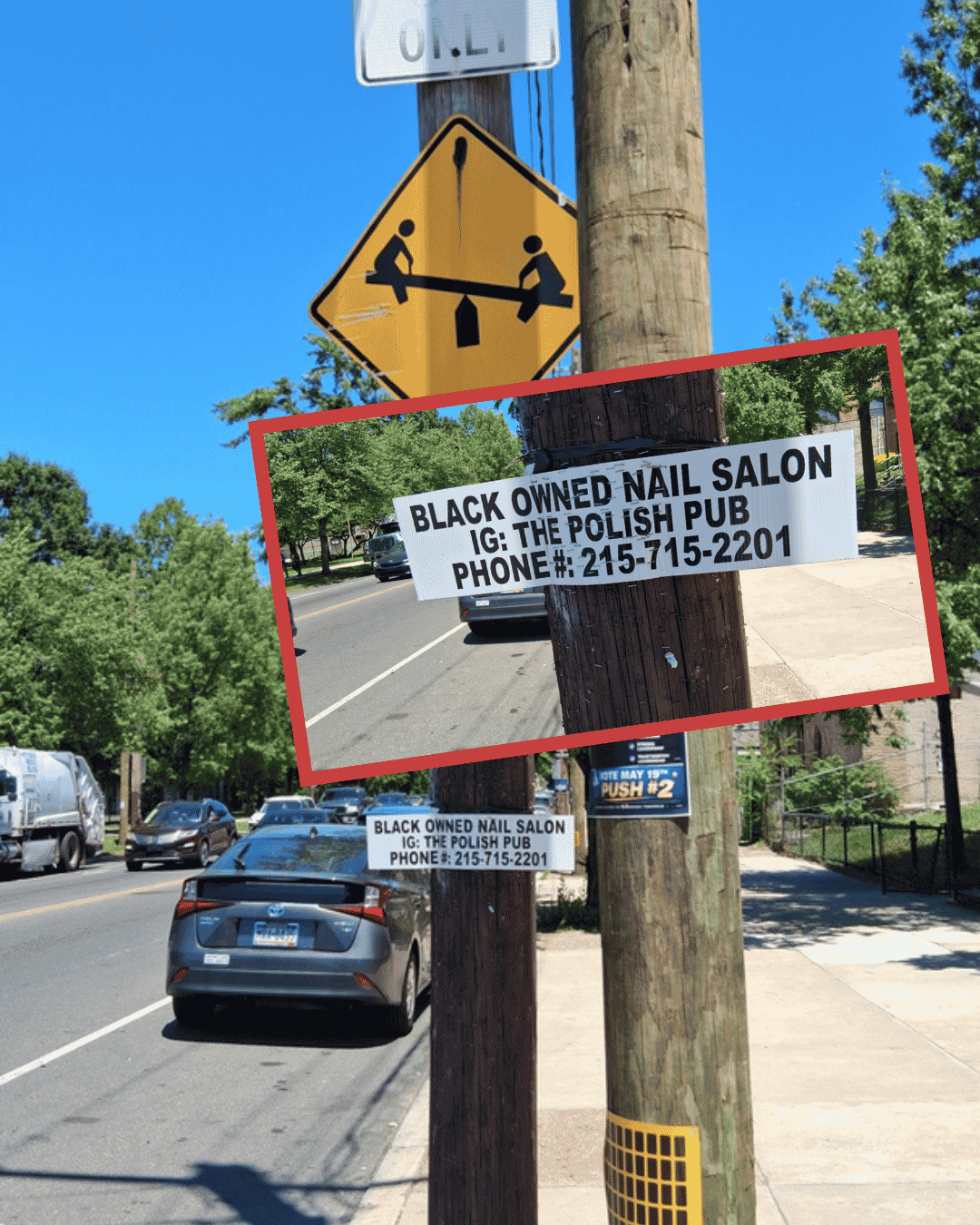
This is where local solutions like Kash Mobs, Black business crawls, vendor markets, church buying campaigns, fraternity and sorority business expos, community directories, and neighborhood spending networks matter.
They are not complete solutions to gentrification.
They will not fix zoning, lending discrimination, commercial rent pressure, public school underfunding, or development incentives by themselves.
But they do address one important problem:
Scattered consumer power.
A Kash Mob or local buying campaign says: instead of waiting for dollars to randomly reach local businesses, let’s organize attention and spending.
That matters because small businesses do not only need one-time sales.
- They need repeat customers.
- Email lists.
- Digital followers.
- Vendor relationships.
- Local press.
- Business referrals.
- Access to institutions.
- Bulk orders.
- Corporate contracts.
- Community trust.
The best version of a buying campaign is not just a shopping day.
It is a customer acquisition strategy for Black-owned and local businesses.
A Marketplace Is Not Enough. The Follow-Up Matters.
A one-day event can create momentum.
But the real economic value depends on what happens after the event.
- Did the businesses collect customer contacts?
- Did the event create repeat buyers?
- Were vendors connected to accountants, lenders, web designers, insurance agents, or procurement opportunities?
- Were local property owners involved?
- Did any businesses get help negotiating leases or improving operations?
- Was there a directory after the event?
- Was spending tracked?
- Did churches, sororities, fraternities, alumni groups, schools, or local institutions commit to future purchasing?
This is how a cultural event becomes economic infrastructure.
Otherwise, the money moves for one afternoon and disappears.
That does not mean the event failed.
It means the community has to turn moments into systems.
Gentrification Rewards Asset Owners
The hard truth is that neighborhood change usually rewards people who own appreciating assets.
That means property owners, developers, landlords, franchise operators, investors, and businesses with strong leases or capital access are positioned to benefit.
Renters, undercapitalized small businesses, informal workers, and legacy residents often carry more risk.
- They absorb higher costs.
- They face displacement pressure.
- They watch familiar businesses close.
- They see public and private investment arrive after the neighborhood becomes attractive to outsiders.
This is why ownership matters.
Culture can create the demand.
But ownership captures the upside.
That is the difference between being recognized and being paid.
The Media Narrative Has Economic Value Too
Gentrification is not only built through real estate.
It is also built through narrative.
When a historically Black neighborhood gets described as “up-and-coming,” “rediscovered,” “authentic,” or “finally changing,” that language can help attract new residents, investors, tourists, and businesses.
But those stories often skip the question of who made the neighborhood valuable in the first place.
They may highlight new restaurants without asking who owns them.
They may celebrate a neighborhood’s style without naming the people who created it.
They may promote the culture while treating longtime Black residents as background.
That narrative has economic value.
Media attention can shape where people move, where investors buy, where tourists visit, and where businesses open.
So the ownership question also applies to storytelling.
- Who controls the narrative?
- Who gets featured?
- Who gets erased?
- Who gets paid when Black culture becomes a destination?
View this post on Instagram
What Black Communities Can Build Now
The solution cannot be only emotional attachment to place.
It has to become strategy.
That means Black communities need more community land trusts, commercial ownership models, cooperative businesses, local investment clubs, business improvement strategies with accountability, digital directories, procurement networks, credit-ready entrepreneurs, estate planning, and institutions willing to direct real purchasing power locally.
It also means churches, Divine Nine organizations, alumni associations, chambers of commerce, neighborhood groups, schools, and civic organizations can play a practical role.
They already have trust.
They already gather people.
They already influence behavior.
The next step is turning that trust into repeatable economic systems.
Not just one event.
- A calendar.
- A directory.
- A buying pledge.
- A vendor database.
- A local procurement pipeline.
- A neighborhood ownership fund.
A way to measure whether dollars are circulating or leaking out.
The Policy-to-Pocket Issue
Gentrification does not happen by accident.
It is shaped by zoning decisions, public infrastructure, tax incentives, policing patterns, school investment, transit access, lending practices, development subsidies, and who gets heard by city agencies.
When a city suddenly finds money for streetscape upgrades, bike lanes, parks, plazas, farmers markets, and business improvement districts after higher-income residents arrive, longtime residents notice.
The question is not whether neighborhoods deserve investment.
They do.
The question is why investment so often arrives in a form that raises property values without protecting the people who stayed through the years of disinvestment.
That is the policy-to-pocket story.
Public decisions can increase private asset values.
But if Black residents do not own enough of the assets, they experience more of the cost than the gain.
The Lesson From Harlem Still Applies
The Harlem video asked a direct question in 2013.
The same question is alive today in Bed-Stuy, Compton, South Side Chicago, Detroit, New Orleans, and other Black cultural centers.
Where is the money going?
- Who owns the land?
- Who owns the businesses?
- Who controls the narrative?
- Who gets the financing?
- Who captures the upside when the neighborhood becomes valuable?
- And who carries the risk when the costs rise?
Gentrification is not only a story about newcomers.
It is a story about power, ownership, and whether Black cultural value becomes Black economic wealth.
The answer cannot be nostalgia alone.
- It has to be ownership.
- It has to be organized spending.
- It has to be local business infrastructure.
- It has to be policy pressure.
- It has to be institutions moving dollars with intention.
Because if Black culture helps make a place valuable, Black communities should not be the last to benefit from that value.
Economic Implication
Gentrification turns neighborhood culture into economic value through real estate, retail, tourism, media, and lifestyle branding. Without ownership, Black communities may create the value while outside investors, landlords, developers, and brands capture the financial upside.
Why It Matters
This is a wealth-building issue. The fight is not only to preserve Black neighborhoods culturally, but to protect and expand Black ownership of land, storefronts, businesses, media narratives, and local institutions.
Your City, Your Take
What is the biggest ownership question in your city: housing, storefronts, land, tourism, media narrative, or public investment?
Latest posts by normbond (see all)
- LeBron Took an $8 Million Deal. The 76ers May Capture the Bigger Economic Win. - July 24, 2026
- Lina Khan Is Entering New York City’s Development Machine. Who Gets the Land, Contracts, and Upside? - July 22, 2026
- If Workplace Race Data Disappears, Discrimination Becomes Harder to See—and Harder to Prove - July 22, 2026

And let’s not forget Philly. New Yorkers have displaced Black residents in historically Black neighborhoods and received 5 years tax abatement .