



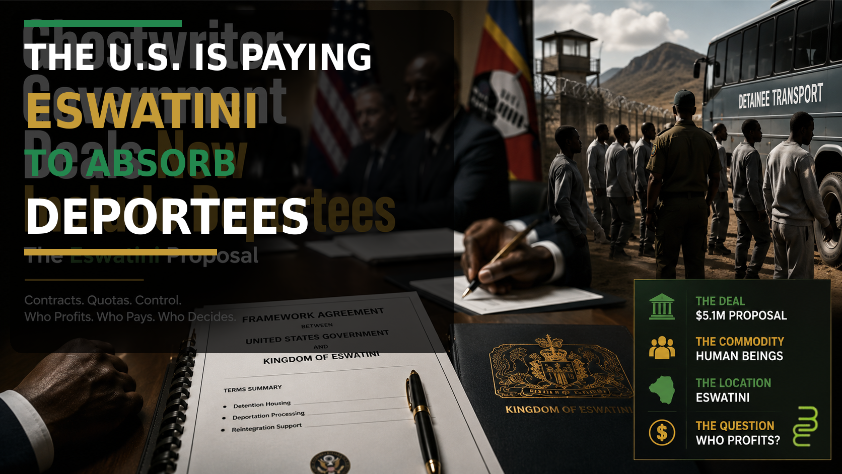
Eleven more migrants deported by the Trump administration have arrived in Eswatini, raising the total number sent there to 29 under a $5.1 million agreement, according to Reuters.
Lawyers say the deportees are being detained despite having already served sentences in the United States. Only two of the 29 have reportedly been released and repatriated.
This is not only an immigration story.
It is also an economic story about how governments can move people, liability, detention costs, political pressure, and public money across borders.
The surface issue is deportation. The deeper issue is outsourcing.
Deportation Becomes a Paid Service
The economics behind this story are direct: the U.S. pays, Eswatini receives funds, and deported people become the transferred burden.
Prior Reuters reporting said Eswatini was to receive $5.1 million in exchange for hosting up to 160 deportees. The deal has been challenged by lawyers and rights advocates, especially because many deportees are reportedly being held in prison conditions even after completing U.S. sentences.
That turns deportation into something larger than removal.
It becomes a state-to-state services arrangement.
The U.S. gains capacity to remove people it does not want to keep. Eswatini gains payment and responsibility. Deportees lose control over where they are sent, how long they are held, and what legal system governs their next move.
Who Controls the System?
The ownership question here is not about a private company. It is about state power.
The U.S. controls deportation policy, enforcement priorities, and the decision to use third-country transfers. Eswatini controls the detention environment once people arrive. Deportees control almost nothing.
That matters because economic power is not only about who owns a business.
It is also about who controls movement, confinement, paperwork, payment, and jurisdiction.
When a person is moved from the U.S. to a country that is not their home country, the legal and economic consequences become harder to see. The public can lose track of where responsibility begins and where accountability ends.
Who Captures the Upside?
The U.S. captures the immediate policy upside.
It can say people were removed. It can reduce domestic detention pressure. It can export a politically sensitive enforcement problem into another jurisdiction.
Eswatini captures the financial upside through the agreement. The payment may support border or migration management capacity, but the public still deserves transparency about how the money is used, who oversees it, and what costs the local prison system absorbs.
The deportees do not capture upside.
They carry the uncertainty.
Who Carries the Risk?
The risk falls on deportees first.
They face detention, separation from family, limited legal leverage, and the possibility of being moved again. Lawyers and civil-rights groups carry the burden of tracking people across borders and challenging a system that is intentionally difficult to monitor.
Families carry emotional and financial costs.
Local prison systems carry operational pressure.
Eswatini’s public institutions carry the reputational risk of becoming part of another country’s enforcement strategy.
And Black and immigrant communities carry a broader warning: when governments build paid removal systems, vulnerable bodies can become line items in international agreements.
Why This Matters to Black Communities
This story sits at the intersection of race, migration, state power, public money, and the global Black world.
Eswatini is a Black African nation being paid to absorb people removed by the United States.
Many migrants affected by global enforcement systems come from Black, brown, formerly colonized, or economically vulnerable countries. The question is not only whether the U.S. can deport people.
The question is what kind of market is being created.
Who gets paid when people are removed?
Who governs them after removal?
Who is accountable if they are detained without clear legal recourse?
And who disappears from public view once the transaction is complete?
This is the economic architecture behind immigration enforcement.
It shows how policy can move from border control to paid international burden-shifting.
It shows how public money can be used to buy capacity in poorer countries. And it shows how people with the least control over the system can become the asset being transferred.
The Bottom Line
The U.S.-Eswatini deportation arrangement reveals a hard truth: immigration enforcement is not only a legal system. It is also a financial system.
Money moves. Jurisdiction moves. Risk moves.
But the people at the center of the deal may have the least power to move at all.

Latest posts by normbond (see all)
- NC A&T Students Marched 45 Minutes to Vote. The Bigger Story Is Who Controls Access. - October 17, 2026
- Black Family Wealth Fell 25%. The Ownership Gap Is the Bigger Story. - October 16, 2026
- Rihanna Turned a TikTok Live Into a Storefront. That Changes the Economics of Celebrity Attention. - October 14, 2026